








TL;DR
- 68% of enterprises face financing constraints despite record global cash reserves.
- Procurement inefficiency traps up to 23% of working capital (Deloitte).
- Digital procurement platforms can reduce the cash conversion cycle by 18–25 days.
- AI-driven P2P and supplier portals help unlock 7–9% in working capital savings.
- Procurement must evolve from cost center to strategic liquidity engine.
- Organizations embracing this shift see measurable gains in resilience, risk, and ROI.
The Financial Imperative of Modern Procurement
Managing financing constraints and ensuring supplier liquidity has become a board-level priorities in today’s volatile global economy. As credit markets tighten and supply chain disruptions persist, organisations face a dual challenge: securing the capital needed for growth while supporting suppliers’ financial health. The solution? Procurement efficiency—an often underleveraged lever that can unlock working capital, mitigate risk, and drive sustainable value across the enterprise.
The Global Liquidity Challenge: Why Procurement Matters
Despite record corporate cash reserves—estimated at $7.1 trillion globally in 2024—over 68% of enterprises report moderate-to-severe financing constraints, according to the IMF.
This paradox is driven by two structural issues:
- Operational Inefficiency: Up to 23% of working capital is trapped in suboptimal procurement processes (Deloitte).
- Supplier Fragility: 42% of SME suppliers face cash flow crises, threatening supply continuity (IMF).
Why is this important? Because procurement is uniquely positioned to address both challenges, unlocking liquidity for the enterprise while strengthening the financial resilience of suppliers.
The Economic Consequences of Financing Constraints
Financing constraints are not just a CFO headache; they have deep, measurable impacts on corporate performance and macroeconomic stability. Empirical research highlights four primary consequences:
1. Restricting Corporate Growth
Firms facing financing constraints experience reduced capacity for expansion and innovation. Studies show constrained firms have 15–23% lower growth rates compared to their unconstrained peers (EJBM).
2. Reducing Production Efficiency
- Total Factor Productivity (TFP): Financing constraints decrease TFP by 3.7–12.5% through reduced capital investment and R&D capabilities (PMC).
- Resource Allocation: Constrained firms show 18% lower efficiency in capital/labor utilization due to suboptimal investment decisions.
3. Increasing Financial Risk
- Firms with limited access to financing exhibit 30–45% higher bankruptcy probabilities due to reduced liquidity buffers.
- Debt servicing costs increase by 8–12% for constrained firms compared to industry averages (McKinsey).
4. Undermining Financial Stability
- Macroeconomic Impact: A 10% increase in constrained firms correlates with a 1.2–1.8% GDP growth reduction in developing economies (IMF).
- Systemic Vulnerabilities: Sectors with >25% constrained firms show 3x higher contagion risk during economic downturns.
Sector-Specific Impacts
| Sector | Key Finding | Source |
|---|---|---|
| SMEs | 68% report growth limitations due to financing constraints | EJBM |
| Manufacturing | 22% productivity gap between constrained/unconstrained firms | World Bank |
| Tech Startups | 40% reduced innovation output under financing constraints | PMC |
Procurement Efficiency: The Strategic Link to Financial Resilience
From Cost Centre to Value Creator
Historically, procurement was viewed as a cost centre focused on price negotiation and contract compliance. Today, leading organisations recognise procurement as a strategic function—one that can directly impact the balance sheet by optimizing working capital, reducing risk, and enabling growth.
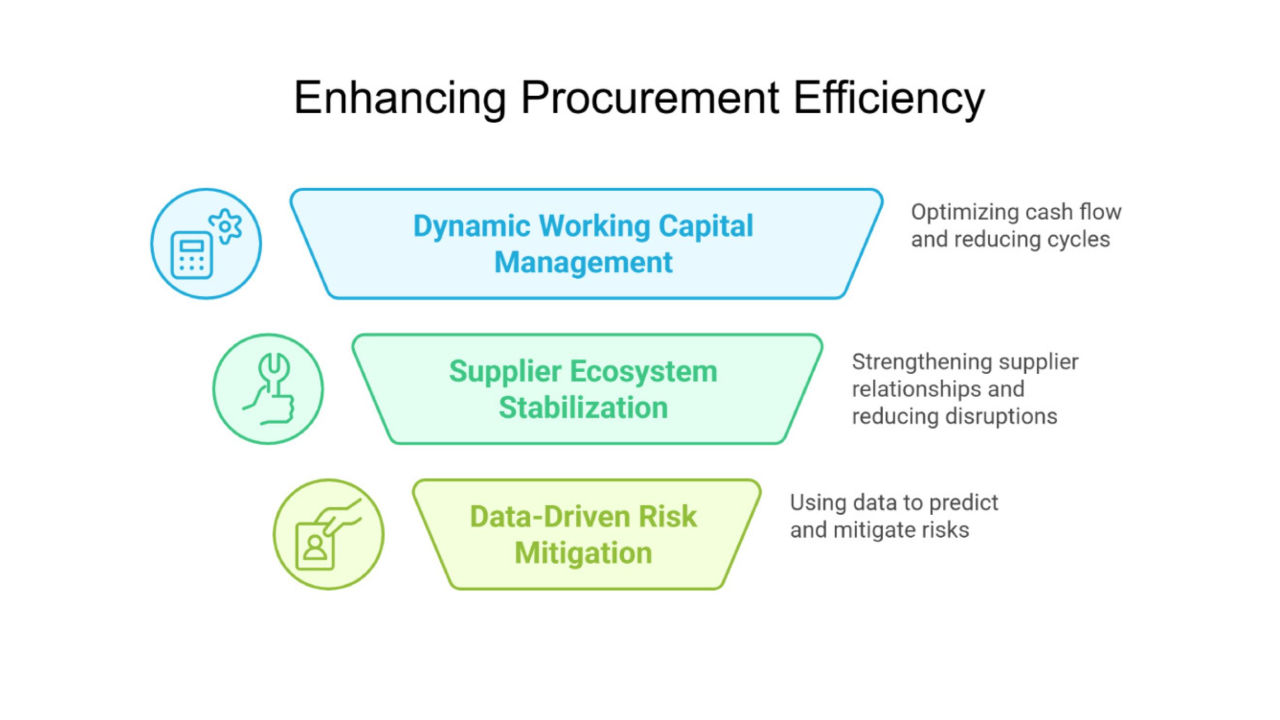
Key Levers of Procurement Efficiency
Dynamic Working Capital Management
- Efficient procure-to-pay (P2P) processes can reduce the cash conversion cycle (CCC) by 18–25 days.
- Automated invoice approvals and dynamic discounting unlock 7–9% in recoverable cash per $100M spend.
Supplier Ecosystem Stabilization
- Real-time supplier risk assessments and collaborative payment planning reduce supply disruptions by 35%.
- Liquidity-weighted supplier selection improves retention and continuity during economic shocks.
Data-Driven Risk Mitigation
- Predictive analytics enable early detection of financial distress across the supply base.
- Cognitive procurement platforms identify 12–15% input cost advantages through margin-oriented sourcing (McKinsey).
The Digital Procurement Revolution
Digital transformation is accelerating procurement’s financial impact. AI-powered procurement platforms, advanced analytics, and real-time supplier collaboration are no longer optional—they are essential for organizations seeking to thrive under financial constraints.
AI and Predictive Analytics
- 93% accuracy in 6-month working capital forecasts through AI-driven spend analysis.
- Identification of hidden savings and early payment discount opportunities worth 0.8–1.2% of annual spend (McKinsey).
Supplier Collaboration Portals
- Real-time liquidity scoring and automated onboarding reduce supplier risk and enable faster response to market changes.
- Early payment programs and supply chain finance solutions can reduce supplier borrowing costs by 300–500 basis points (The Global Treasurer).
Blockchain and Smart Contracts
-
Blockchain-enabled invoice tracking and smart contracts reduce transaction costs by up to 40% and improve trust across the supply chain.
Implementation Roadmap: Building Procurement-Led Financial Resilience
Phase 1: Liquidity Diagnostic
- Spend Clustering Analysis: Identify 15–20% of working capital trapped in inefficient procurement processes.
- Supplier Financial Health Mapping: Use advanced risk indicators (current ratio, DPO, interest coverage) to stratify supplier risk.
Phase 2: Technology Enablement
- AI-Powered Procure-to-Pay: Automate invoice approvals, dynamic discounting, and supplier onboarding.
- Supplier Portals: Enable real-time collaboration, early payment offers, and risk monitoring.
Phase 3: Continuous Value Capture
- Liquidity KPIs: Track cash conversion cycle velocity, supplier distress alerts, and working capital ROI per procurement dollar.
- Scenario-Based Planning: Use predictive analytics to stress-test procurement strategies against market volatility.
Case Study: Procurement Efficiency in Action
A global manufacturing company facing severe financing constraints implemented a digital procurement transformation:
- Invoice approval times dropped from 23 days to 8 days.
- Early payment discounts captured increased from 12% to 89% of opportunities.
- Supplier retention improved by 3.2x during a period of market volatility.
The result? A $6.8 million annual reduction in inventory carrying costs and a 22-day improvement in DPO (Days Payable Outstanding).
The New Procurement Calculus: From Back Office to Boardroom
The evidence is clear: procurement efficiency is not just a tactical lever—it is a strategic imperative for managing financing constraints and supplier liquidity. As capital becomes scarcer and supply chains more complex, procurement must evolve from a transactional function to a catalyst for financial resilience.
Key Takeaways for Senior Leaders
- Procurement efficiency delivers 3–5x greater financial impact than traditional cost-cutting.
- Digital procurement platforms unlock 7–9% in working capital and reduce supplier risk.
- Collaboration with Finance and Treasury is essential for maximizing procurement’s impact on liquidity.
“Not understanding price adjustment mechanisms can be detrimental to margin. Procurement must become entrepreneurial in managing the P&L.”
– CPO, Global Chemical Conglomerate
The Future: Procurement as a Strategic Liquidity Engine
As organizations look ahead, the most resilient will be those that treat procurement as a balance sheet optimizer and a source of competitive advantage. This requires:
- Investing in digital procurement capabilities
- Embedding predictive analytics and AI into decision-making
- Fostering deep, data-driven supplier collaboration
- Aligning procurement strategy with broader financial objectives
In this new era, procurement is poised to become the central nervous system of corporate financial health—enabling organizations to weather financial storms, support supplier ecosystems, and unlock sustainable value.
References & Data Sources
- IMF Working Paper: SME Liquidity Challenges in Global Supply Chains (2022)
Highlights the prevalence and impact of financing constraints on SMEs globally. - Deloitte: 7 Steps to Build Efficient and Responsive Supply Chains (2023)
Discusses operational inefficiencies and working capital trapped in procurement. - EJBM: Determinants of Financing Constraints (2024)
Empirical analysis of the economic consequences of financing constraints. - PMC: Impact of Financing Constraints on Productivity (2022)
Research on the link between financing constraints and productivity loss. - McKinsey: A New Era for Procurement Value Creation (2023)
Explores procurement’s evolving role in financial performance. - The Global Treasurer: Supplier Finance in the Sourcing Strategy (2013)
Overview of supplier finance programs and their benefits. - World Bank: Financing Small and Medium Enterprises (2020)
Data on SME financing and productivity gaps. - McKinsey: Revolutionizing Procurement with Data and AI (2023)
Insights into AI and analytics in procurement transformation.
Summary of Research Links
- IMF, World Bank, and Deloitte provide macroeconomic and operational data on financing constraints and procurement inefficiency.
- McKinsey, GEP, and Kodiak Hub offer strategic frameworks and case studies on procurement’s financial impact.
- EJBM and PMC deliver empirical evidence on the economic consequences of financing constraints.
- The Global Treasurer details supplier finance strategies for liquidity improvement.
Conclusion
Procurement efficiency stands at the intersection of financial strategy and operational execution. By embracing digital transformation, predictive analytics, and supplier collaboration, organizations can turn procurement into a strategic tool for managing financing constraints and supplier liquidity. The future belongs to those who see procurement not as a back-office function, but as a driver of financial resilience and competitive advantage.
FAQs
Q1. What is procurement efficiency?
Procurement efficiency refers to how effectively an organization manages sourcing, purchasing, supplier relationships, and payments while minimizing cost, risk, and cycle time. Efficient procurement improves working capital, reduces operational friction, and strengthens supplier reliability.
Q2. How does procurement efficiency improve financial resilience?
Procurement efficiency improves financial resilience by unlocking trapped working capital, accelerating invoice processing, reducing supplier risk, and shortening the cash conversion cycle. This enables organizations to maintain liquidity and stability during economic uncertainty.
Q3. Why is procurement critical during financing constraints?
When access to capital is limited, procurement becomes a key lever for liquidity management. By optimizing payment terms, automating procure‑to‑pay processes, and improving supplier collaboration, procurement can reduce dependence on external financing.
Q4. How much working capital can efficient procurement unlock?
Research shows that inefficient procurement processes can trap up to 23% of working capital. Digital and AI‑enabled procurement solutions can unlock 7–9% in recoverable cash per $100M in spend by reducing delays, errors, and manual interventions.
Q5. What role does digital procurement play in financial resilience?
Digital procurement platforms use automation, AI, and predictive analytics to optimize cash flow, identify risk early, and improve supplier visibility. These tools enable faster decision‑making and continuous value creation across the procurement lifecycle.
Q6. How does procurement efficiency support supplier liquidity?
Efficient procurement supports supplier liquidity through faster invoice approvals, early payment programs, supply chain finance, and transparent collaboration. This reduces supplier financial stress and lowers the risk of supply disruptions.
Q7. What KPIs should organizations track to measure procurement‑led financial impact?
Key metrics include cash conversion cycle (CCC), days payable outstanding (DPO), invoice cycle time, supplier risk indicators, working capital ROI per procurement dollar, and early payment discount capture rates.
Q8. How does AI enhance procurement efficiency?
AI enhances procurement by forecasting working capital needs, identifying savings opportunities, predicting supplier financial distress, and enabling scenario‑based planning. AI‑driven platforms also improve accuracy, speed, and strategic decision‑making.
Q9. Can procurement efficiency deliver more value than cost‑cutting?
Yes. Procurement efficiency delivers 3–5x greater financial impact than traditional cost‑cutting by improving liquidity, reducing risk, and enabling sustainable growth rather than one‑time savings.
Q10. Why should procurement leaders collaborate closely with Finance and Treasury?
Close collaboration ensures procurement strategies align with broader financial objectives such as liquidity management, risk mitigation, and capital efficiency. This alignment transforms procurement into a balance‑sheet‑driven strategic function.
Related Reads:
- Read Blog on Procurement Process: 7 Steps for Optimal Efficiency and Cost Savings
- Read Ebook on Mastering Modern Procurement: Your Guide to Efficiency & Innovation
- Zycus Procure to Pay Software Solutions
- Procure-to-Pay Process Workflow- Transformation Guide for Success
- The 4 Under-the-Radar P2P Challenges in Procurement
- Top 10 Winning Skills for Procurement Professionals
- Advanced Procurement Strategies You Need to Know