

Supplier Management Software (SMS) is the digital platform that centralizes supplier information, streamlines onboarding, monitors performance, manages risk and compliance, and enables collaboration across the full supplier lifecycle. It acts as a single source of truth for supplier data while connecting sourcing, contracts, P2P, and risk functions into one unified ecosystem.
As supply chains become more global, regulated, and interdependent, Supplier Management Software provides the governance, visibility, and operational efficiency needed to manage suppliers not just as vendors — but as strategic partners.
Read more: Supplier Management–Benefits, Process, & Best Practices
Why Supplier Management Software Matters
Supplier relationships define procurement performance. Poor data, slow onboarding, unclear obligations, and limited visibility into supplier performance or risk can disrupt operations, inflate costs, and create compliance exposure.
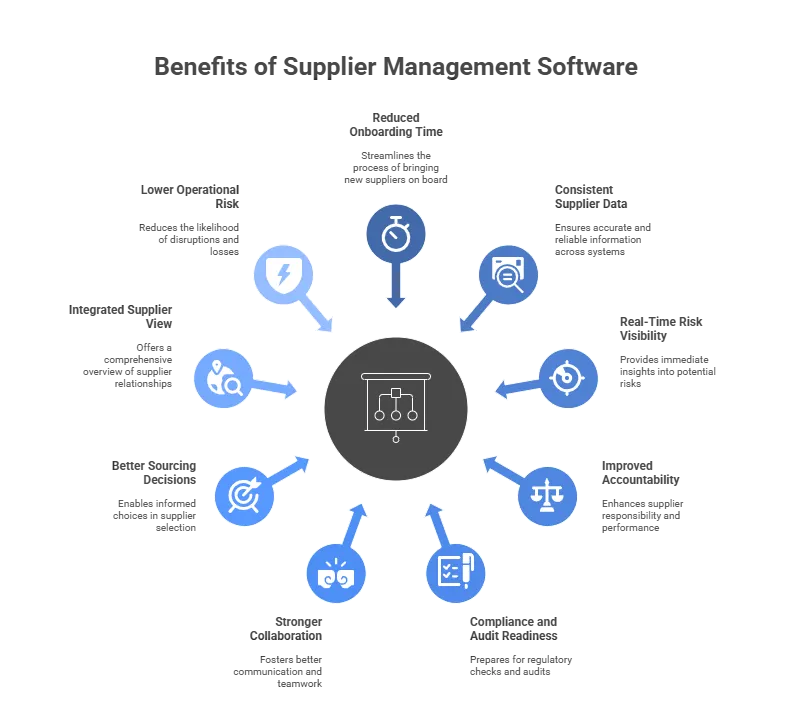
Supplier Management Software addresses these gaps by providing:
- Reliable Supplier Data: A centralized, validated repository for all supplier information.
- Faster Supplier Activation: Automated onboarding and qualification workflows.
- Smarter Risk Management: Continuous monitoring across financial, cyber, ESG, and operational domains.
- Stronger Supplier Performance: Clear KPIs, scorecards, and CAPA workflows improve reliability.
- Better Compliance: Automated tracking of certifications, audits, and policies.
- Improved Collaboration: Shared portals and communication tools enhance engagement and trust.
In modern procurement, Supplier Management Software is no longer optional — it is fundamental to resilience, agility, and strategic value creation.
The Complete Supplier Management Lifecycle
1. Supplier Discovery & Pre-Qualification
The lifecycle begins with identifying and screening potential suppliers based on capability, financial stability, regulatory exposure, and strategic fit. Digital platforms streamline this step using structured RFIs, ESG assessments, and sanctions checks, helping procurement shortlist only eligible suppliers.
Systems aligned with Zycus-style intelligence often enhance this phase with automated external data pulls, early-risk signals, and AI-driven supplier recommendations.
2. Supplier Onboarding & Data Collection
Once suppliers are selected, onboarding workflows capture legal, financial, tax, ESG, cybersecurity, and insurance details with automated validations to ensure accuracy. Self-service portals reduce back-and-forth exchanges and accelerate approval cycles.
Zycus-aligned intake and workflow engines support this by routing tasks, validating fields against master data, and ensuring onboarding adheres to compliance requirements.
3. Supplier Information Management (SIM)
A complete supplier profile is maintained in a single record — including contact details, performance history, certificates, risk scores, and contract links. Automated reminders track expiry dates and ensure documentation remains up to date.
Platforms inspired by Zycus SIM centralize this information, synchronizing supplier data across sourcing, contracting, P2P, and risk modules to ensure consistency.
4. Supplier Qualification & Approval
Suppliers undergo category-specific qualification to validate capability, compliance, sustainability commitments, and operational readiness. Qualification depth varies based on supplier tier and business risk.
Zycus-aligned qualification flows often use configurable scoring models, automated risk checks, and policy-driven rules that determine which suppliers qualify for sourcing events.
5. Supplier Performance Management (SPM)
Performance is monitored continuously using indicators such as OTIF, quality levels, responsiveness, SLA adherence, and cost competitiveness. Scorecards and dashboards provide a clear view of trends and improvement areas.
Systems modeled after Zycus SPM connect these metrics directly with sourcing and renewal decisions, ensuring performance insights guide future spend strategy.
6. Supplier Risk & Compliance Management
Risk is tracked across financial, operational, cyber, ESG, and regulatory dimensions using both internal data and external feeds. Alerts trigger when a supplier’s risk profile changes — prompting review or mitigation actions.
Zycus-aligned platforms often incorporate external risk intelligence (similar to Merlin Risk Radar), combining news, sanctions, and ESG signals with internal performance data for a 360° risk view.
7. Supplier Collaboration & Communication
A shared workspace (via supplier portals) enables ongoing communication around PO updates, documents, performance, audits, CAPA actions, and QBRs. This ensures suppliers and buyers maintain transparency and alignment.
Portals similar to those in the Zycus ecosystem improve collaboration through real-time visibility, structured communication threads, and automated notifications for tasks and updates.
8. Supplier Development & Innovation
Strategic suppliers participate in improvement programs focused on quality, delivery, sustainability, or cost optimization. Co-innovation and capability-building initiatives strengthen long-term value.
Zycus-aligned supplier development tools help track milestones, progress metrics, and outcomes of joint improvement projects.
9. Supplier Offboarding & Transition Management
When a supplier needs to be discontinued, structured offboarding ensures the closure of contracts, settlement of outstanding obligations, mitigation of risks, and safe transition to alternate suppliers.
Integrated platforms similar to Zycus ensure offboarding decisions flow through sourcing, contracts, and supplier master data to maintain governance and auditability.
10. Continuous Feedback Loop Across S2P
Supplier data from every stage feeds back into sourcing, contracting, P2P, and analytics — creating an integrated intelligence loop.
Systems aligned with the Zycus architecture use this closed-loop model to update supplier scores, optimize sourcing decisions, and strengthen overall supplier ecosystem resilience.
Core Components of Supplier Management Software
Each component is designed to make the entire supplier ecosystem more accurate, compliant, and strategic.
1. Supplier Self-Service Portals
Enable suppliers to update profiles, upload documents, respond to tasks, view performance ratings, and acknowledge POs — reducing admin workload on procurement.
2. Supplier Master Data Management (MDM)
Ensures consistent supplier data across sourcing, contracts, P2P, ERP, and finance systems.
Advanced platforms automatically cleanse duplicates and enforce taxonomy standards.
3. Document & Certification Management
Tracks expiry, compliance requirements, and document validations.
Auto-notifications ensure suppliers remain audit-ready at all times.
4. Risk & Compliance Engine
Monitors sanctions, ESG news, cyber exposure, financial health, and regulatory updates across jurisdictions.
Software assigns risk scores and triggers mitigation workflows.
5. Performance Dashboards & Scorecards
Measure OTIF, defect rates, SLA adherence, and responsiveness.
Scorecards are used during QBRs and renewal decisions.
6. Issue, CAPA & SLA Tracking
Centralized logs capture every non-conformance.
CAPA workflows assign owners, deadlines, and evidence requirements.
7. Integration with S2P & ERP Systems
Supplier data syncs with sourcing, contracting, P2P, invoicing, and analytics engines.
This eliminates inconsistency and ensures true end-to-end visibility.
8. Analytics & Predictive Insights
Visual dashboards track supplier performance, risk trends, compliance status, and spend distribution.
Predictive models highlight possible disruptions or supplier health issues.
KPIs for Supplier Management Software
| KPI | What It Measures |
| Onboarding Cycle Time | Speed of activating a new supplier |
| Data Completeness Score | Accuracy and completeness of supplier profiles |
| Certificate Compliance % | Up-to-date certifications and documents |
| Supplier Risk Score | Health across financial, operational, ESG, cyber |
| Performance Rating | Quality, delivery, and service scores |
| CAPA Closure Time | Efficiency of issue resolution |
| Supplier Portal Adoption | Engagement and collaboration levels |
Key Terms in Supplier Management
- SIM (Supplier Information Management)
- SPM (Supplier Performance Management)
- SRM (Supplier Risk Management)
- CAPA (Corrective and Preventive Action)
- SLA (Service-Level Agreement)
- Supplier 360° View
- Vendor Master Data
- Tiering (A/B/C)
FAQs
Q1. What is supplier management software?
Supplier management software is a centralized digital platform that manages the entire supplier lifecycle onboarding, data management, performance tracking, compliance, risk monitoring, and collaboration to create a controlled and efficient supply base.
Q2. What are the benefits of SRM software?
SRM software improves supplier visibility, accelerates onboarding, enhances compliance, strengthens risk management, streamlines performance evaluations, reduces operational effort, and enables better sourcing and renewal decisions through a unified supplier 360° view.
Q3. What is the difference between supplier management software and vendor portals?
Vendor portals provide a workspace for suppliers to update information or collaborate, while supplier management software is the broader system that governs supplier data, risk, performance, compliance, and workflows across the entire Source-to-Pay lifecycle.
Q4. How does supplier management software reduce risk?
It continuously monitors financial, operational, ESG, and cybersecurity indicators, triggers alerts when supplier health changes, and enforces compliance requirements — preventing disruptions and strengthening supply-chain resilience.
Q5. Who benefits most from supplier management software?
Procurement, supply chain, finance, quality, legal, and compliance teams all rely on SMS for accurate supplier data, risk insights, performance tracking, and fully audit-ready documentation.
References
- The Why, What And How of the supplier management in procurement
- Taking a 360° Approach to Supplier Management
- Supplier Risk And Performance Management: Best Practices For KPI Creation
- Seven Keys to Better Sourcing and Supplier Management
- 9 Steps to Effective Supplier Risk Management Tool
- Supplier Information Management: The Key to Unlocking Working Capital
- Supplier Performance Management using DMAIC Principle