





Procurement AI offers many promising use cases, but the first investment must do more than improve productivity. To prove the ROI for procurement automation, it must create value that procurement can attribute, and finance can verify. This article examines why agentic sourcing is a compelling place to begin, how its returns differ from less measurable AI initiatives, and what CPOs need to build a credible business case from one category to the wider sourcing portfolio.
TL;DR
- Agentic sourcing connects procurement AI investment with measurable sourcing cost savings at the point of contract award.
- Benchmark-driven events make it easier to compare award rates against prior contracts, market data, and sourcing savings benchmarks.
- The ROI of procurement automation software should include both documented price improvements and the additional categories enabled by shorter sourcing cycles.
- A focused category pilot can provide the evidence needed to build a CFO-ready procurement AI business case and estimate a wider deployment timeline.
Why Does Procurement AI Investment Stall at the CFO Stage?
The argument for AI in procurement is not difficult to make to a CPO. It is difficult to make to a CFO.
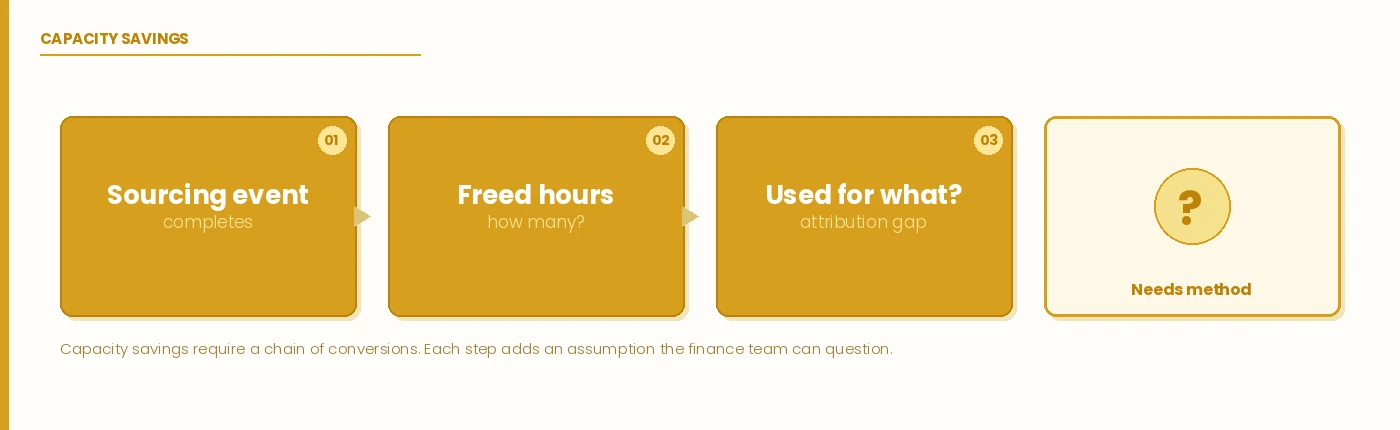
The CFO’s question is not whether AI will make the procurement team more productive. It is whether the investment will produce returns that appear in the income statement. Productivity gains, cycle time compression, and analyst capacity recovered from manual work are all real. None of them appear directly as a line in the P&L. They require an attribution model and a set of assumptions that a finance team will challenge at every step.
That is the gap where most procurement AI projects stall: savings that are diffuse, complex to attribute, and slow to materialize against a capital budget cycle.
The Hackett Group’s 2026 Procurement Key Issues study found that only 45% of procurement teams expect to deliver increasing savings in 2026, down from 55% the prior year.
Our read: the mandate is getting harder to meet while the tools to meet it remain unproven in the CFO’s terms.†
Why Are Procurement Cost Savings Difficult to Attribute?
Procurement generates value in two forms.
- Price: a negotiated rate lower than the benchmark or the prior contract.
- Capacity: the ability to run more sourcing events, catch more renewals, and extend competitive discipline across more of the portfolio.
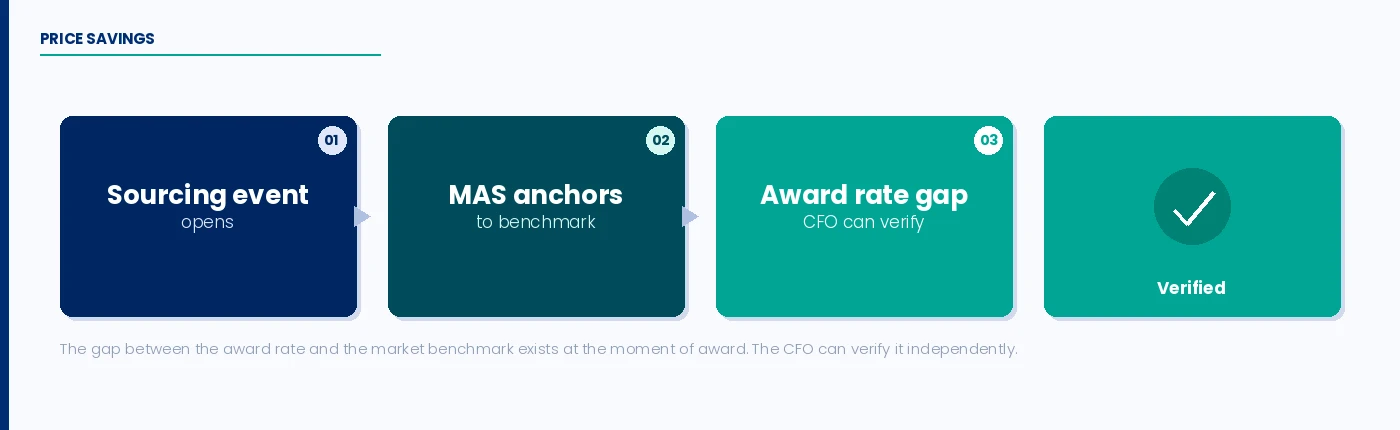
Price savings are auditable. The gap between the new rate and the benchmark is a number the CFO can verify independently. Capacity savings require an assumption about what the freed hours produced, and that assumption is long enough for a skeptical finance team to challenge at every step.
Agentic sourcing is a high-ROI entry point because it generates price savings first. A better-informed starting position produces a more competitive event. A more competitive event produces a better award. And the award is a number finance can verify at contract signature.
World Commerce & Contracting research (2025) found that organizations lose an average of 11% of the value negotiated in their procurement contracts during execution, the gap between what was agreed at award and what was delivered. Our read: an award made without an external price anchor starts that clock from a weaker position, because there is no benchmark to measure later drift against.
Why Is Strategic Sourcing a High-ROI Procurement AI Use Case?
Enterprise AI investment competes across business functions. Finance AI, HR AI, supply chain AI, and customer-facing AI all make claims on the same capital allocation cycle. Each generates value. Not all generate value in a form the CFO can verify without a conversion methodology.
Strategic sourcing is distinctive because the output is a contract, and the contract has a rate. The rate is measurable against a benchmark and against the prior period. The saving lands in a verifiable form at the moment of award, with no conversion rate or utilization assumption required.
That is what makes strategic sourcing the right entry point for procurement AI investment: the business case is grounded in a number the finance team can independently verify, not in a model that depends on assumptions procurement controls.
Read More About What is Savings Realization?
What Does the Return from Agentic Sourcing Look Like?
The return has two components.
The first is price at award. When sourcing begins with a should-cost model built from market benchmarks, the award is measured against an external reference rather than against the bids themselves. The team knows whether the winning bid reflects market value. That knowledge produces a better award.
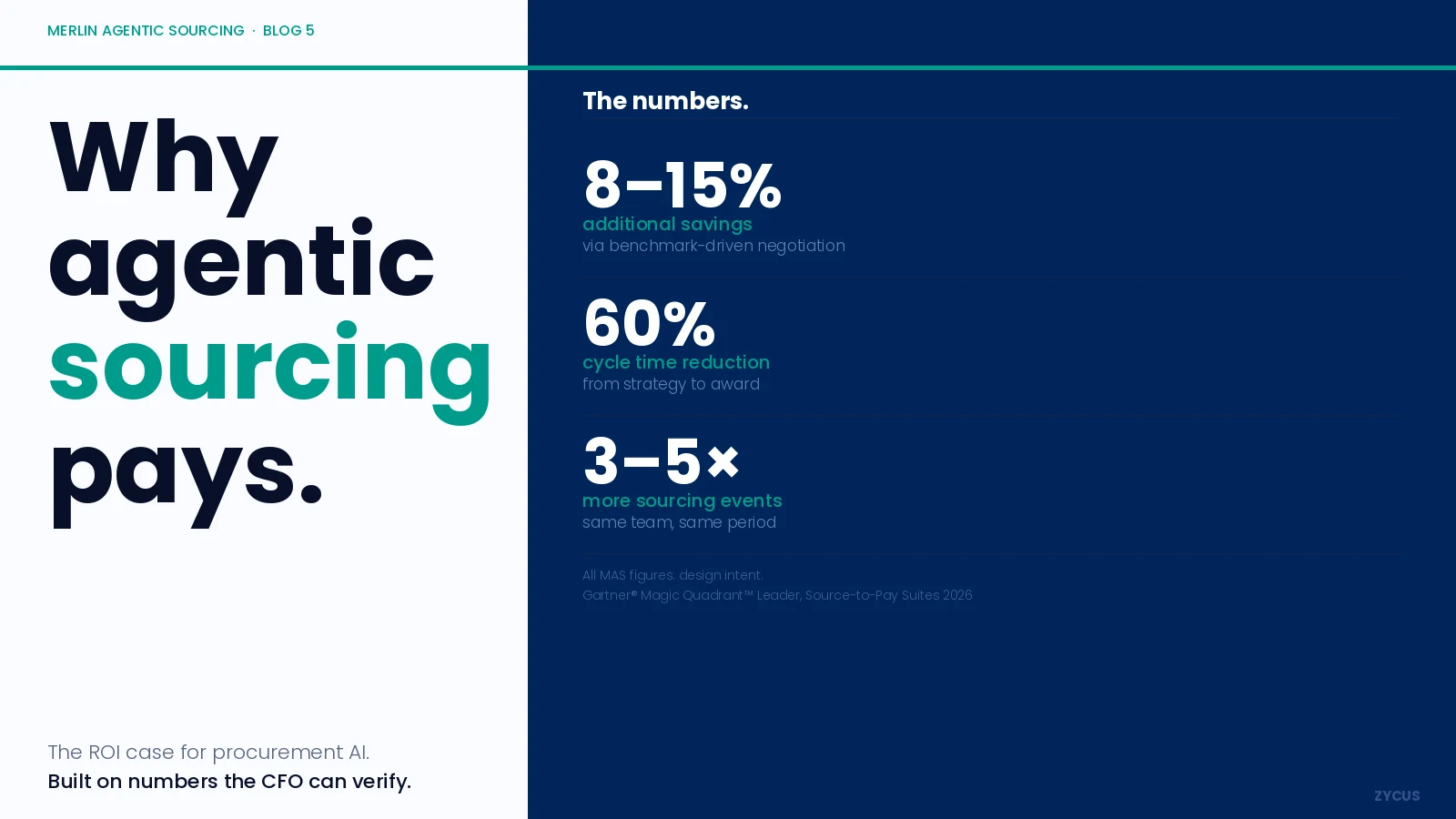
The second is coverage. Merlin Agentic Sourcing is designed to deliver 8 to 15% additional savings via benchmark-driven negotiation. A faster sourcing cycle enables the same team to cover more categories in the same period. Categories that previously had no sourcing event, because the team had no capacity for them, now generate documented savings.
The Hackett Group’s 2025 Digital World Class® research found that top-performing procurement organizations deliver 2.6x greater return on investment than their peers. Our read: top performers run more categories through an intelligence chain. The rest inherit positions set by others.§
How Does Merlin Agentic Sourcing Generate Savings the CFO Can Measure?
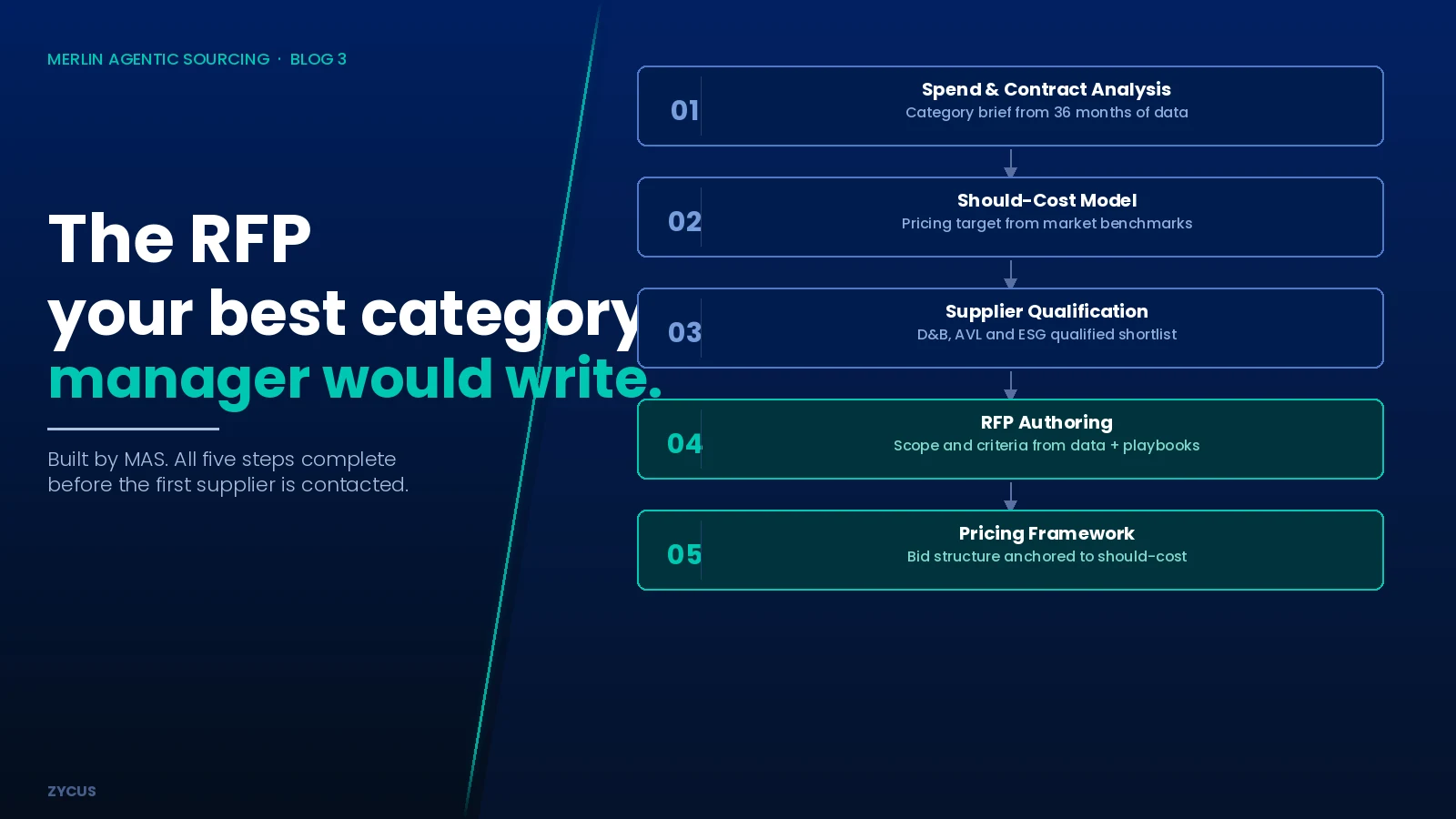
Merlin Agentic Sourcing (MAS) is designed to produce the inputs that determine whether a sourcing event captures maximum value before the first supplier is contacted.
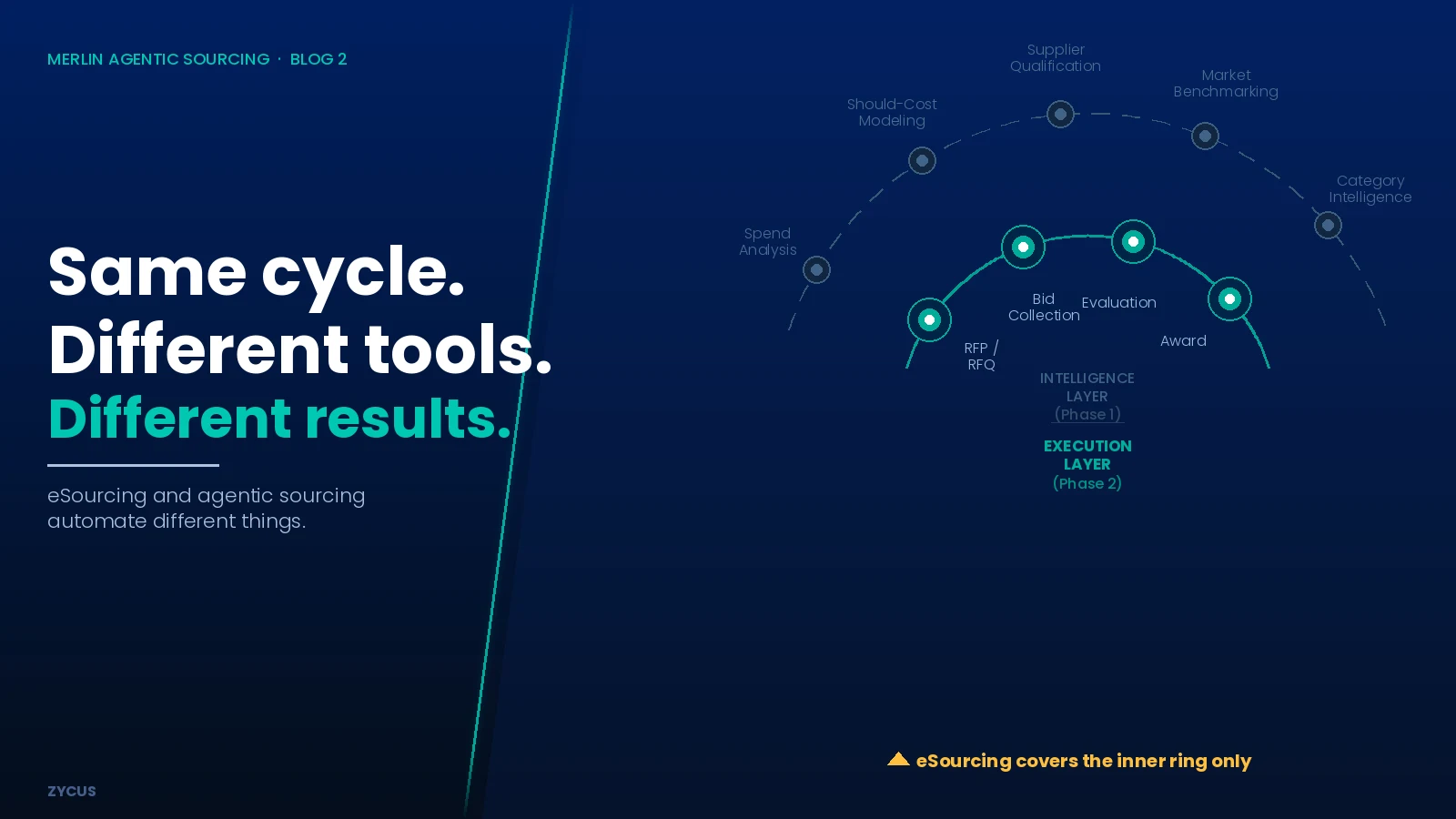
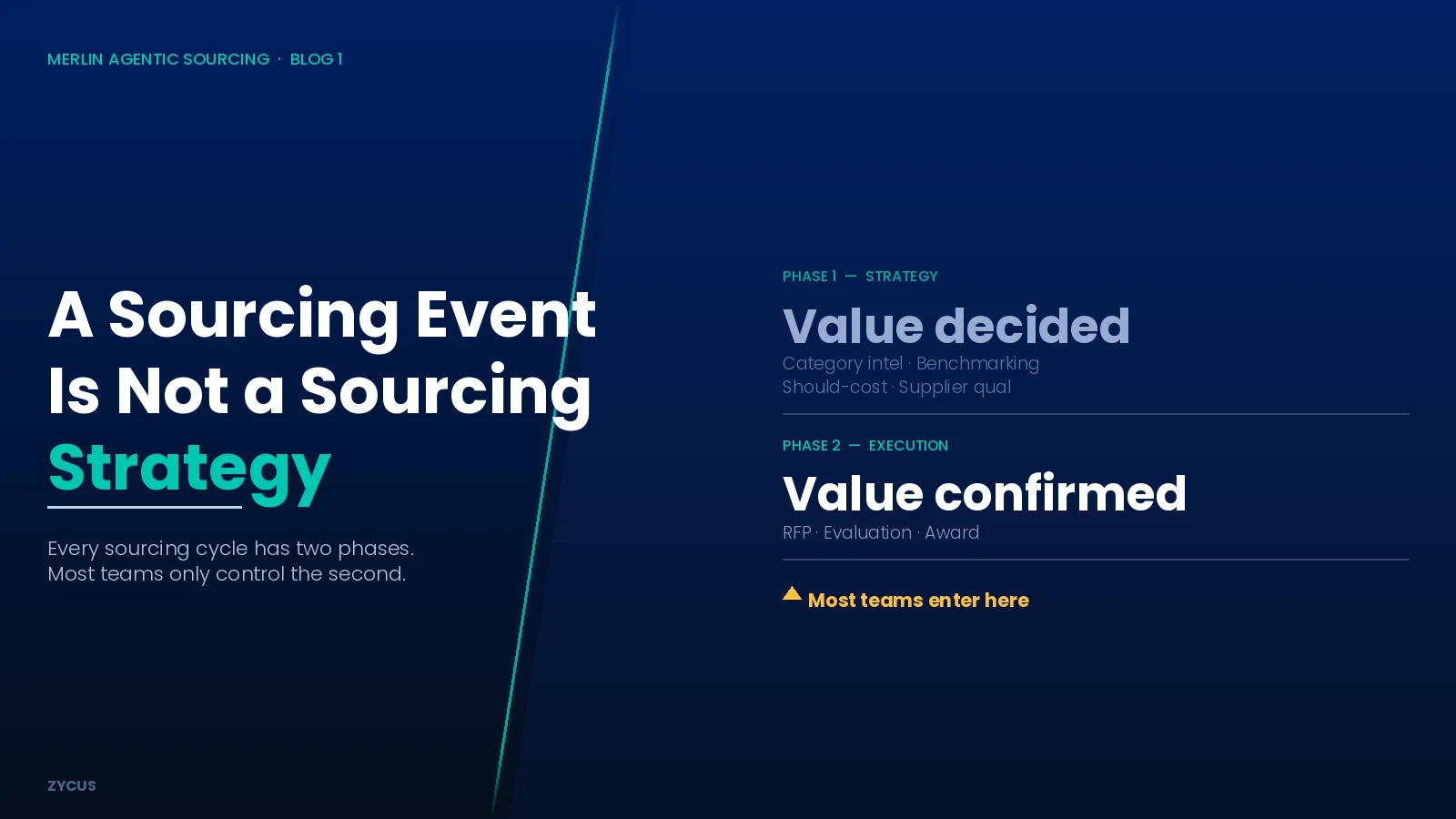
The Strategy Flow runs spend and contract analysis for the category, builds a should-cost model from commodity indices and labor benchmarks, and qualifies suppliers against D&B financial health, approved vendor list compliance, and ESG criteria. The Execution Flow authors the RFP from past playbooks, runs structured supplier communications, and produces four-scenario award modeling with savings calculations attached.
The savings calculation is what the CFO needs. Each event produces a documented comparison between the award rate and the benchmark, and between the award rate and the prior period. The savings are auditable, per-event, and attachable to a specific sourcing cycle.
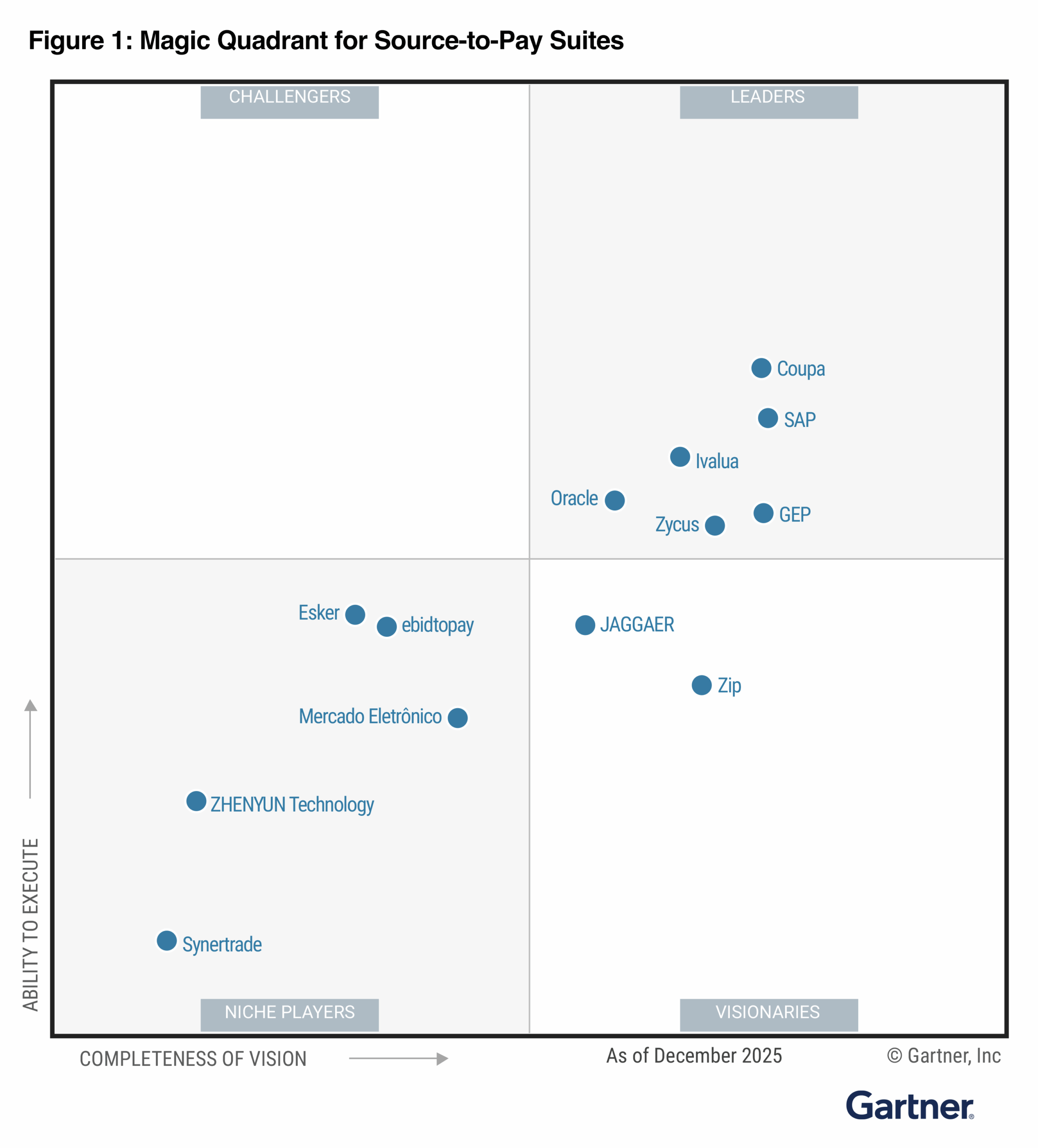
Zycus was recognized as a Leader in the Gartner® Magic Quadrant™ for Source-to-Pay Suites, January 2026. MAS is designed to cut total sourcing cycle time from strategy to award by up to 60%. That compression means more sourcing events are possible in the same calendar year. More events means more documented savings across the portfolio.
What Does the Business Case Look Like at Portfolio Scale?
The entry point: one category, one sourcing cycle, one documented saving. Run MAS on a category where the benchmark exists and the prior contract rate is known. Take the gap between the award and the benchmark to the CFO.
The portfolio argument follows. If one category generates a documented saving and MAS enables the team to cover three to five times more categories in the same period, the arithmetic scales. The cumulative saving is a sum of per-event measurements, not an estimate that requires a productivity model.
What Should a CPO Include in a Procurement AI Business Case?
Three items make the business case.
- A baseline: what is the current sourcing event volume and savings rate, and what share of the strategic portfolio receives no sourcing event today?
- A pilot result: one category, one cycle, one documented gap between the award and the market benchmark.
- A projection: if MAS enables three to five times more events at the pilot savings rate, what does the twelve-month portfolio saving look like? That is how the board’s savings target gets met, not just reported. And it is a business case the CFO can evaluate without a productivity methodology.
Read More About The Procurement CFO Playbook
Merlin Agentic Sourcing is part of the Merlin Agentic Platform, Zycus’s Intake-to-Outcomes architecture for governed, multi-agent procurement.
See Merlin Agentic Sourcing run a documented sourcing event on a category from your portfolio.
Ready to maximize your return on investment with next-generation procurement technology? Request a Demo today to see how agentic sourcing can deliver immediate value and drive high ROI for your team.
Frequently Asked Questions
Q1. Why is agentic sourcing a better ROI entry point than other procurement AI applications?
Most procurement AI generates value through efficiency: faster processing, reduced manual work, better data visibility. These gains are real but require an attribution model to connect to the income statement. Agentic sourcing generates value through price: a better-informed starting position produces better award rates. Price savings are auditable at the moment of contract award. The CFO can verify them independently, without a methodology owned by procurement.
Q2. How does MAS produce savings the CFO can verify?
MAS generates a should-cost model before the event opens, runs a structured event against that anchor, and produces four-scenario award modeling with savings calculations attached. Each event documents the gap between the award rate and the benchmark and between the award rate and the prior period. The savings are per-event and per-category, not aggregate estimates derived from productivity assumptions.
Q3. What is a realistic payback period for an agentic sourcing deployment?
The payback depends on the scale of the category portfolio, the current savings rate per event, and the coverage gap: the proportion of strategic categories that currently receive no sourcing event because the team lacks capacity. The pilot category provides the per-event savings rate that anchors the projection. Multiply that rate by the additional categories the team can cover once cycle times compress, and compare the result against the deployment cost. That arithmetic is the payback calculation, and every input in it comes from the organization’s own data rather than from a vendor benchmark.
Q4. What is a realistic enterprise procurement automation ROI timeline?
The timeline depends on category value, data readiness, implementation cost, and the savings captured in the first events. Because maximizing the ROI for procurement automation requires clear, verifiable financial outcomes, agentic sourcing can establish evidence much earlier than broad transformation programs, allowing every completed sourcing cycle to produce a measurable award outcome.
Q5. How do you scale the business case from one category to the portfolio?
The per-event saving from the pilot establishes a rate. That rate, applied across the categories MAS enables the team to cover in the first year, produces a portfolio projection. The projection is conservative when based on the pilot rate alone. As MAS runs more categories, MAS is designed so that benchmark data deepens and should-cost models sharpen as more categories run through it, which is why a projection built on the first pilot rate is a conservative one.
Q6. Does MAS require a specific technology infrastructure before deployment?
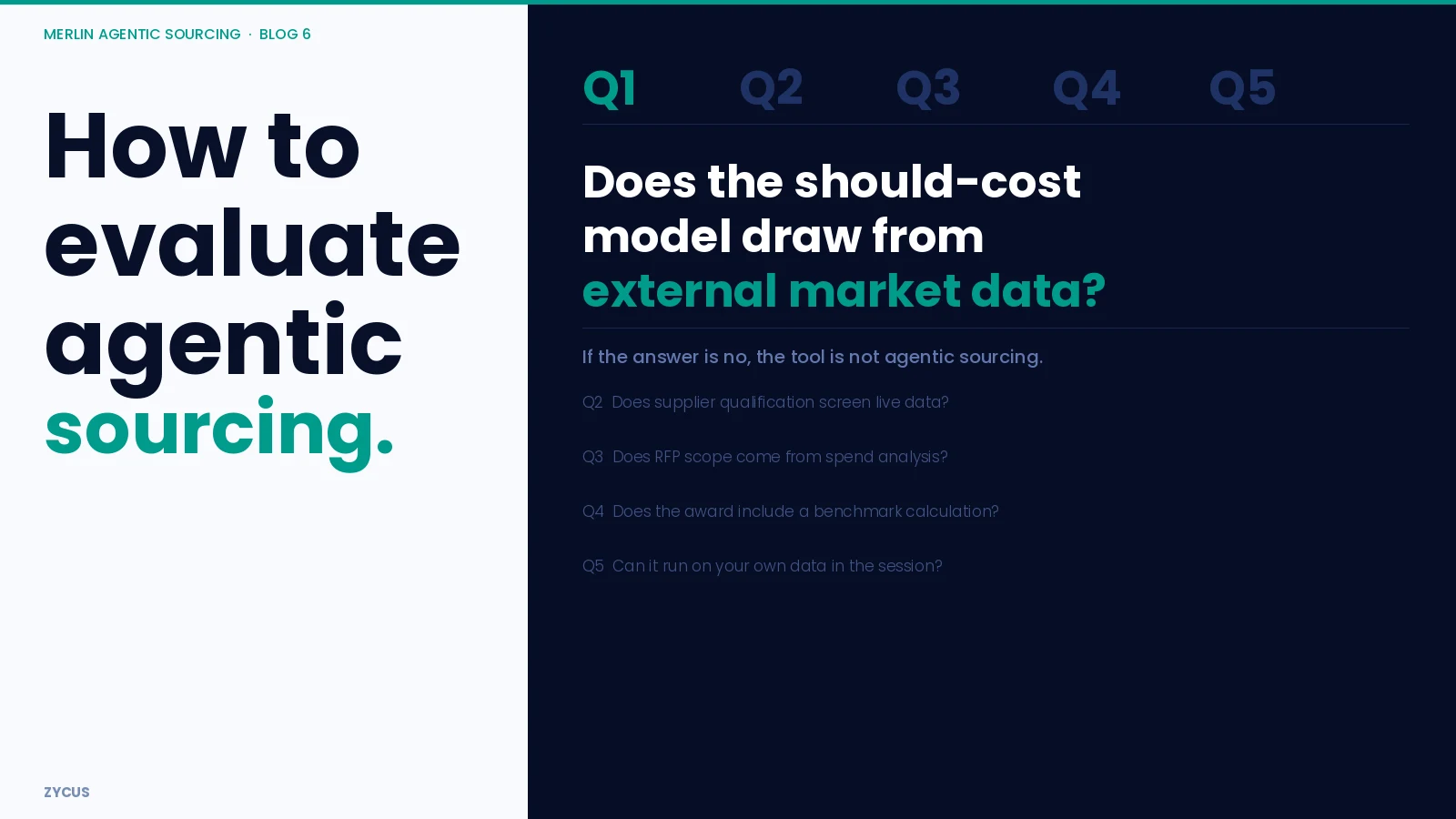
MAS is designed to run within the existing procurement environment. It does not require a full source-to-pay replacement or a specific ERP configuration to produce its core outputs. The intelligence chain draws on the category’s transaction history and external market data. The Execution Flow connects to the organization’s existing sourcing and supplier management workflows. The entry point is a single category, not a platform migration.
Related Reads
- Source to Pay Automation Revolution: How Procurement Workflow Automation is Transforming Businesses
- Understanding Dynamic Discounting: A Smart Way to Boost Cash Flow
- What is Autonomous Sourcing? And Why Every CPO Should Care Now
- How to Prove Procurement Software ROI (With Real Numbers)
- Harnessing Agentic AI: Revolutionizing Spend Analysis for Smarter Procurement