





Walk into almost any procurement function in 2026 and you’ll find the same architectural problem: a sourcing tool from one vendor, a contract system from another, a supplier portal from a third, AP automation from a fourth, and an ERP underneath that doesn’t fully trust any of them.
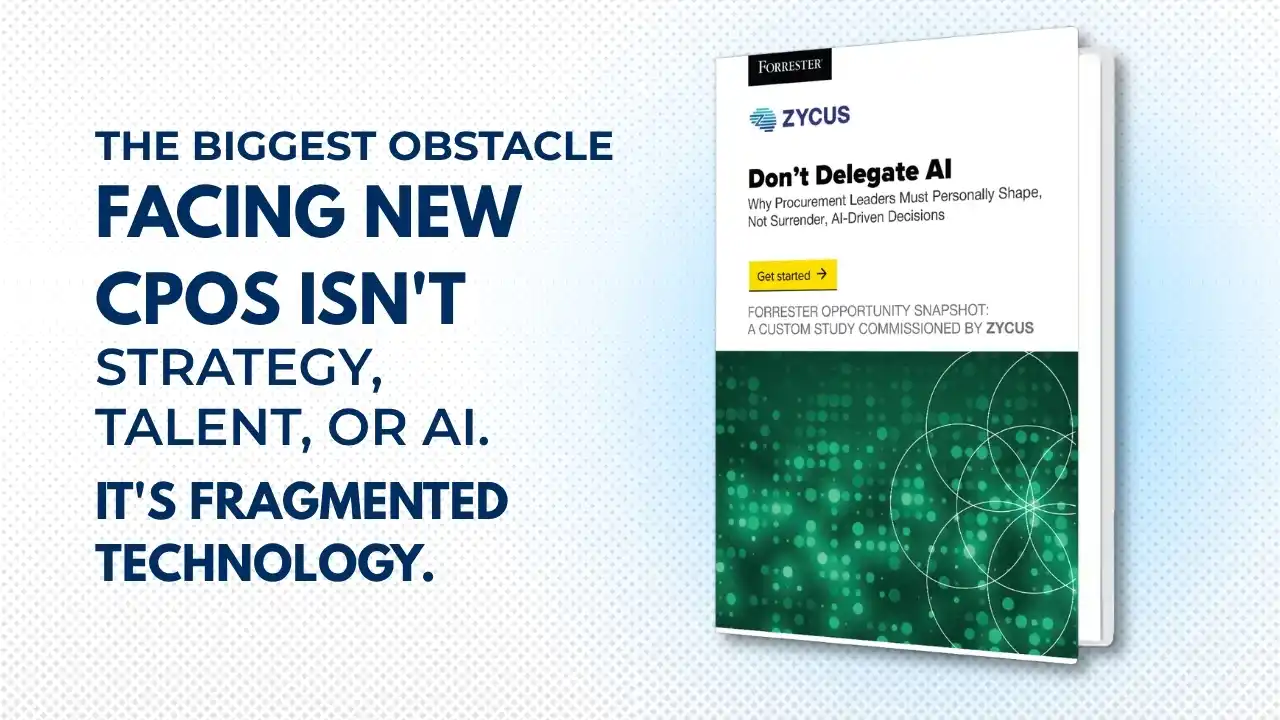
It’s a familiar landscape — and according to Forrester’s latest research, it’s the single biggest obstacle facing new Chief Procurement Officers. 68% of new CPOs cite fragmented or outdated technology as their top challenge. Not strategy. Not talent. Not even AI. Technology fragmentation.
Here’s why that matters more than it sounds, and what the leading CPOs are doing about it in their first 90 days.
How Procurement Got So Fragmented
The fragmentation problem isn’t anyone’s fault — and that’s part of why it’s so hard to fix. The current state is the cumulative result of fifteen years of rational decisions:
- A procurement leader in 2012 picked the best-of-breed sourcing tool because the ERP module was weak.
- The contracts team rolled out a CLM platform in 2016 to handle GDPR-driven legal requirements.
- An AP automation tool was added during a finance transformation in 2019.
- A supplier risk monitoring product came in after a high-profile supplier failure in 2021.
- Each one was a good decision in isolation. Together, they created the current mess.
The result is what one CPO in transportation and logistics described to Forrester: committed people doing a lot with very little — fragmented data, legacy tech, and manual procure-to-pay processes that meant the team was firefighting rather than shaping supplier strategy.
The Five Hidden Costs of a Fragmented Stack
Most CFOs know fragmentation is suboptimal. Few have a clear picture of what it actually costs. The Forrester data, combined with operational benchmarks, points to five concrete impact zones.
1. Speed Collapse
67% of CPOs cite speed of execution as the top area where procurement falls short. Fragmentation is the primary culprit. Every system handoff is a wait state. Every duplicate data entry is a rework loop. A new supplier onboarding that should take three days takes three weeks because the data has to flow through four tools, each with its own validation logic. An AI-guided front door like Merlin Intake can compress this dramatically by capturing structured demand at the point of origin and routing it across the S2P stack without manual handoff.
2. Data Quality Erosion
58% of new CPOs cite poor data quality as a top challenge. When the same supplier exists with slightly different names across four systems, when spend categorization is done independently in each tool, when contract terms aren’t reflected in the PO system — every analysis becomes suspect. This is exactly the gap that agentic spend data management was built to close: AI agents that classify, enrich, and analyze every transaction in real time, so every step is grounded in clean data.
3. AI Initiatives That Don’t Scale
48% of new CPOs cite disconnected digital and AI initiatives as a top challenge. Only 37% feel confident their technology is ready to integrate agentic AI workflows. The reason is simple: agentic AI needs clean, connected data to make decisions. When the data is scattered across systems with different schemas, AI projects either stall at proof-of-concept or deliver isolated wins that never aggregate. This is why a unified Merlin Agentic AI Platform — with native integration across intake, sourcing, contracts, and AP — is structurally different from bolting AI onto a fragmented stack.
4. Lost Realized Value Post-Award
Forrester’s research is direct about this: procurement functions systematically lose realized value in post-award compliance, obligation tracking, and scope execution. The savings negotiated in sourcing don’t fully materialize because the contracts, the POs, and the actual invoices live in different systems and aren’t reconciled cleanly. AI-driven contract intelligence like Merlin for Contracts — which auto-extracts metadata, identifies obligations, and flags renewal risk — plus integrated Merlin AP automation, is how leading CPOs are closing the savings-to-P&L gap.
5. Strategic Blind Spots
Fragmented technology means fragmented visibility. The CPO can’t easily answer: What’s my total exposure to this supplier? Where are my off-contract spend leakages? Which categories are at highest risk from geopolitical disruption? Merlin Analytics addresses this directly with conversational intelligence — ask a question in plain language and get a real-time answer that connects spend, supplier, contract, and risk data across the S2P stack. In a function now expected to anticipate risk and influence enterprise strategy, this kind of visibility isn’t a feature — it’s the substrate.
Why Adding Another Tool isn’t the Answer
The instinct, when something isn’t working, is to buy a better tool for that specific problem. The Forrester data suggests the opposite. Adding tools is what got procurement here. The CPOs who are succeeding aren’t acquiring more capabilities — they’re consolidating onto integrated platforms.
The architectural shift is from procurement-as-toolbox to procurement-as-platform: a single data foundation, a unified workflow layer, and connected execution across sourcing, contracts, supplier management, and procure-to-pay. Zycus describes this as Intake-to-Outcomes — a connected agentic platform that runs from the moment a request is captured by Merlin Intake to the moment savings show up in the P&L. The benefit isn’t just operational efficiency. It’s that the platform itself becomes the substrate on which agentic AI, governance, and strategic insight can scale.
What Leading CPOs Demand From Their Tech Partners
Forrester’s research surfaced what new CPOs now expect from technology partners — and the bar has moved meaningfully higher. The most cited expectations:
- Strong data security controls — non-negotiable, especially as AI processes sensitive supplier and contract data
- Transparent AI governance — model behavior visibility, audit trails, explainability
- Regular model updates — to prevent drift and keep AI aligned with evolving processes
- Human-in-the-loop checkpoints — expected by 1 in 3 CPOs as a default capability
- Configurable autonomy levels — different processes deserve different levels of human oversight
- Seamless integration with S2P and ERP platforms — expected by 1 in 5 CPOs as table stakes
The pattern: CPOs are no longer evaluating technology on features. They’re evaluating it on whether it can serve as the foundation for governed, intelligent procurement at scale.
The 90-Day Foundation Strategy
For a new CPO inheriting a fragmented stack, the temptation is to launch a multi-year platform replacement program. The Forrester data suggests something more pragmatic — and more effective.
Days 1-30: Map the Mess Honestly
Forrester’s data shows 53% of new CPOs prioritize rapid diagnosis of demand and spend flows. That diagnosis must include the technology landscape. Where does data live? Where does it duplicate? Where does it die? Most leadership teams have a sanitized view of the stack. The first 30 days is for getting the unsanitized version.
Days 31-60: Define the Target Architecture
45% of new CPOs assess digital and AI maturity in the second month. This is when the future-state platform decision gets made — not as an IT project, but as a procurement strategy decision with IT as a partner. The question isn’t “what’s the best CLM tool?” — it’s “what’s the integrated foundation we need to support the next five years of procurement strategy?”
Days 61-90: Pilot the Connected Workflow
61% of new CPOs prioritize early efficiency wins. The most credible early win on a fragmentation problem is a single connected workflow — for example, intake to PO with integrated supplier risk and contract validation, or running Autonomous Negotiation Agents on a single tail-spend category. It’s tangible, measurable, and previews what scaled integration looks like. It also builds the political capital for the larger consolidation.
The Foundation Is the Strategy
One CFO interviewed by Forrester — based in manufacturing in Germany — captured the principle most succinctly: focus on the basics first, don’t get distracted by fancy tools, get the data right, define the process, then let AI amplify it. The reverse order is how transformation programs die. Without an integrated data foundation, every initiative downstream — agentic AI, supplier collaboration, ESG, risk management — operates with a permanent handicap.
The CPOs who recognize this in their first 90 days set the trajectory for the rest of their tenure. The ones who treat the foundation as someone else’s problem spend the next three years explaining to the CFO why the savings numbers and the P&L don’t match.
Get the Full Forrester Study
This article focuses on the technology fragmentation problem. The full Forrester Opportunity Snapshot — The New CPO Reality: First 90 Days, commissioned by Zycus — covers the complete 30-60-90 day framework, the AI strategy decisions facing CPOs, and the executive perspectives from leaders across industries.
→ Download the full Forrester study
Continue Reading
Previous in this series: From Cost Center to Strategic Engine: The CPO Role in 2026
FAQs
Q1: What is fragmented procurement technology?
Fragmented procurement technology means a stack made up of disconnected point solutions — separate tools for sourcing, contracts, supplier management, AP, and spend analysis — that don’t share data cleanly with each other or the ERP. The result is duplicated data entry, slow cycle times, and blind spots in spend and risk visibility.
Q2: Why is procurement technology so fragmented?
Most procurement stacks accumulated over a decade or more, with each best-of-breed tool added to solve a specific problem at a specific moment. Mergers, departmental autonomy, and partial implementations compounded the fragmentation. Forrester’s 2026 study found 68% of new CPOs cite this as their top challenge.
Q3: What is source-to-pay (S2P)?
Source-to-pay is the end-to-end procurement process from sourcing and supplier selection through contracting, ordering, receiving, and paying. An integrated S2P platform unifies these stages on a single data foundation, eliminating handoffs and enabling agentic AI to execute across the full lifecycle.
Q4: How does fragmented technology hurt procurement performance?
It slows execution (67% of CPOs cite speed as the top gap), corrupts data quality (58% cite this), undermines AI initiatives (48% cite disconnected AI), and limits the visibility procurement needs to operate strategically. The cumulative impact shows up in lost post-award value and a credibility deficit with the CFO.
Related Reads: