




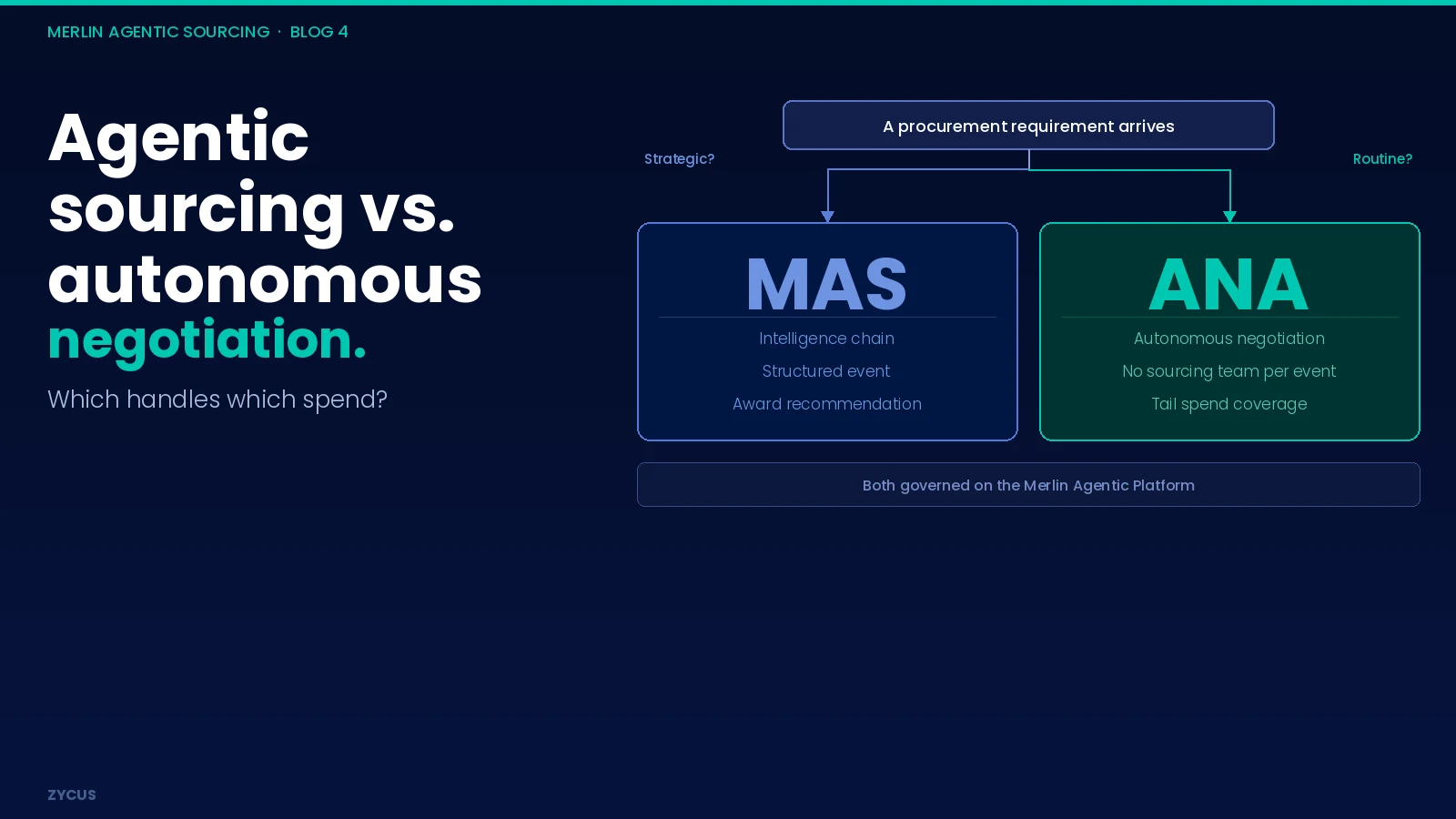

Procurement teams increasingly have access to AI agents that can analyze categories, negotiate with suppliers, and execute sourcing workflows. But agentic sourcing and autonomous negotiation are not interchangeable capabilities and applying the wrong model to the wrong spend can either introduce unnecessary risk or leave valuable automation unused. This article maps the boundary between agentic sourcing vs autonomous negotiation and tail spend, explains where each approach fits, and shows how procurement leaders can route every requirement to the right agent.
Two zones in the spend portfolio. Two agents, each designed for one. Here is how MAS and ANA divide the work and what the portfolio looks like when both run.
TL;DR
- Agentic sourcing and autonomous negotiation address different procurement conditions rather than different levels of the same workflow.
- Strategic sourcing software supports complex categories where market intelligence, supplier qualification, and human judgment shape the award.
- Tail spend automation applies autonomous negotiation to routine, repeatable, and lower risk purchases that sourcing teams cannot manage individually at scale.
- A governed intake and routing model helps procurement assign strategic spend and tail spend to the right agent without leaving gaps between them.
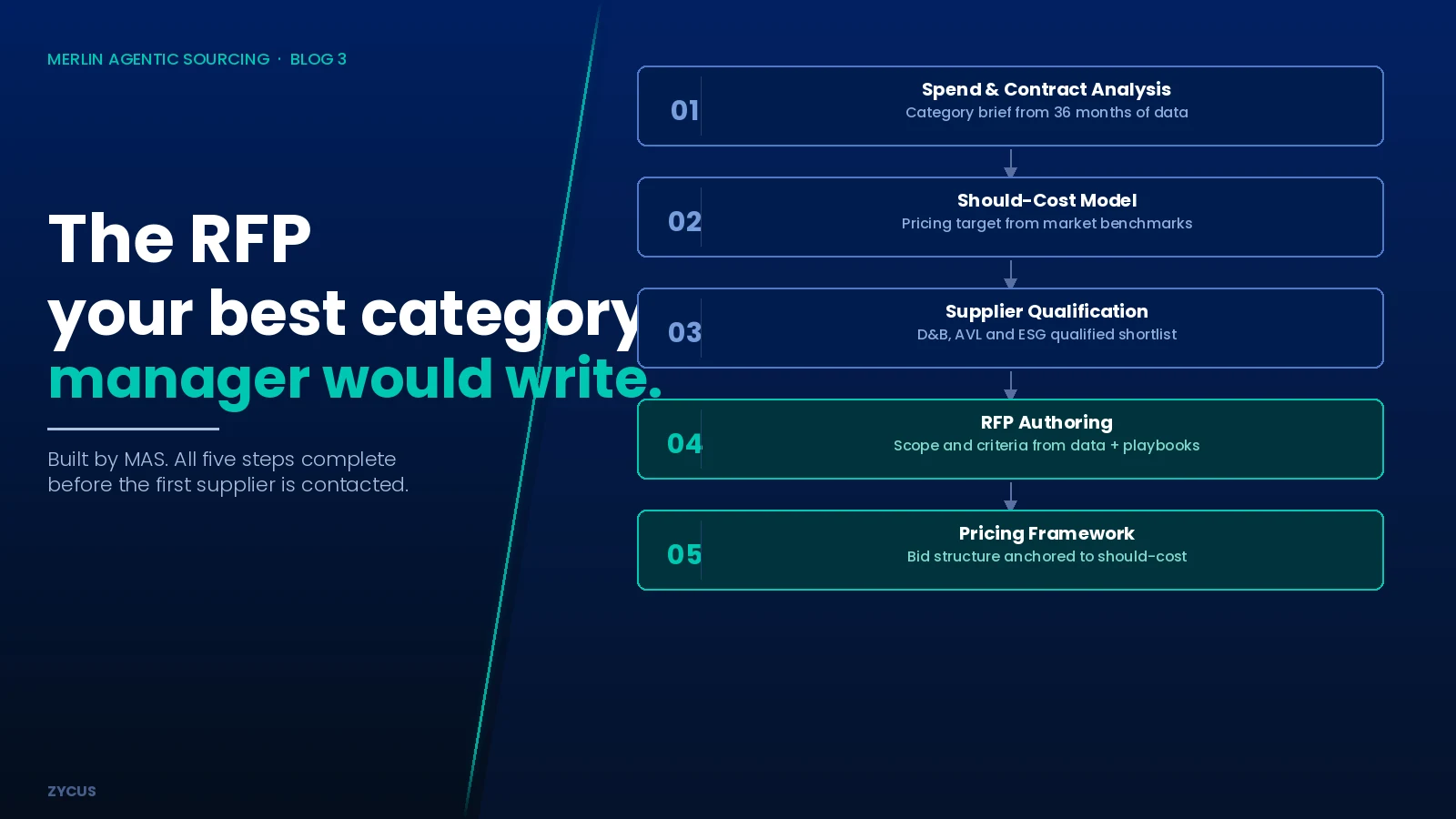
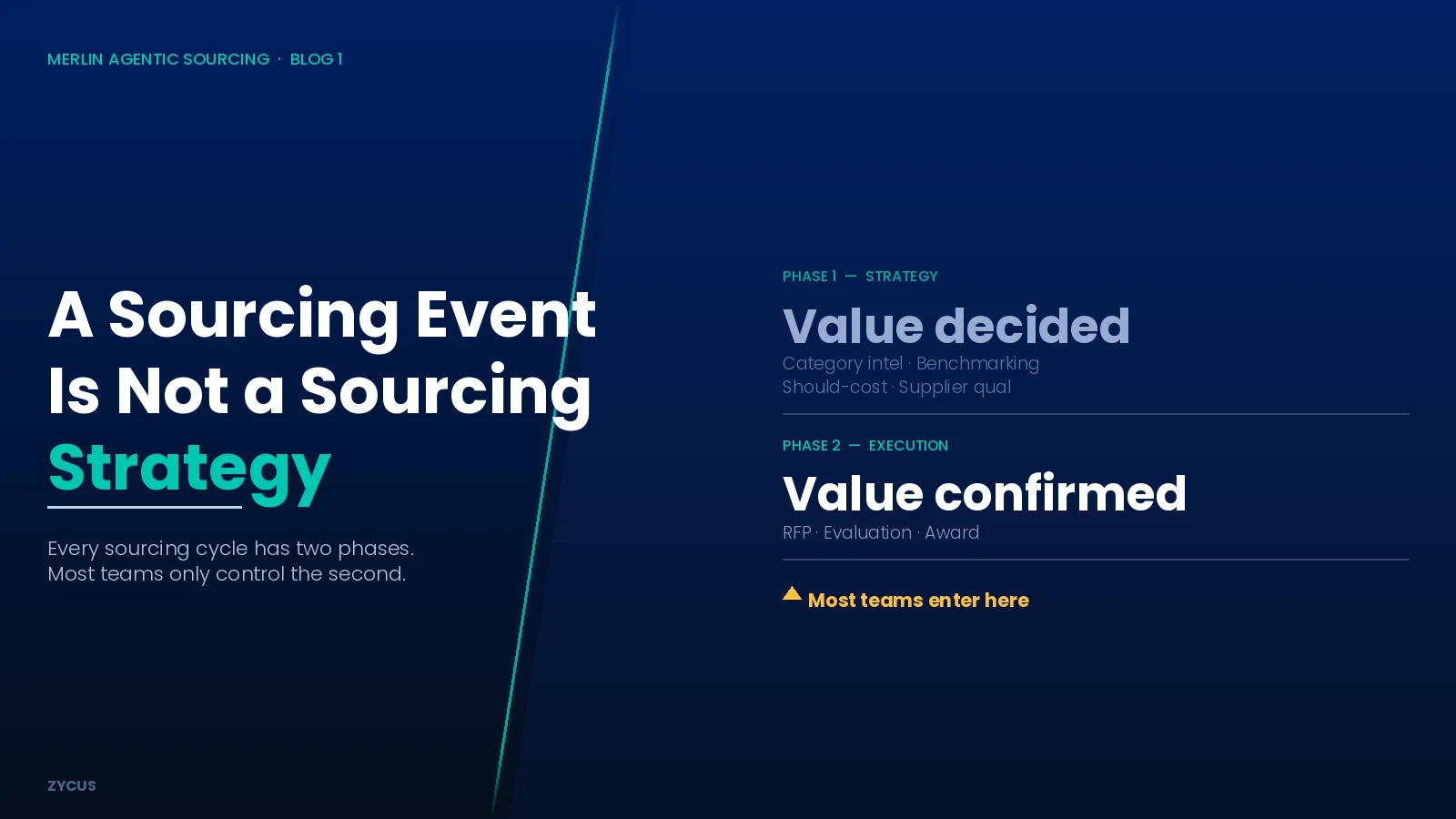
The previous blog in this series showed how MAS builds an RFP for a strategic sourcing event, step by step. This blog maps where each applies. Every spend portfolio has two zones with different characteristics. Understanding the boundary between them is what makes the Merlin Agentic Platform’s two-agent model work.
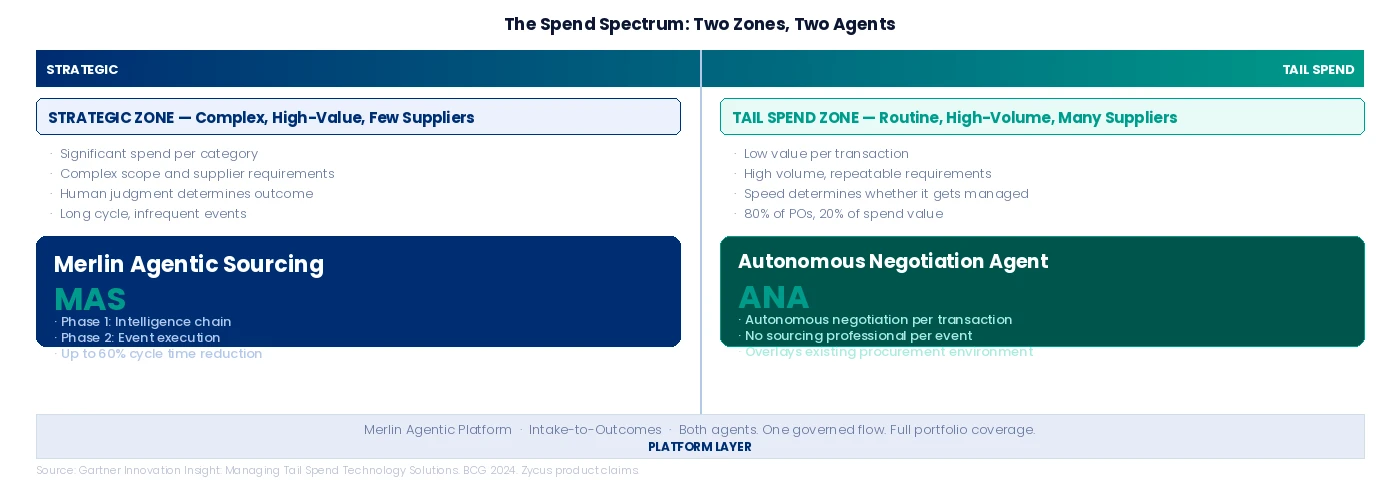
Figure 1: The spend spectrum. MAS covers the strategic zone where human judgment determines the outcome. ANA covers the tail spend zone where autonomous execution at volume is the right answer. The Merlin Agentic Platform governs both.
Why Does the Same Team Need Two Different Agents?
The instinct is to find one tool that handles everything. The problem is that strategic sourcing and tail spend are not the same problem at different scales. They are structurally different problems.
Strategic categories require complex analysis, human judgment, and a sourcing professional who can evaluate competing trade-offs and make a defensible award recommendation. Tail spend requires speed, volume, and autonomous execution, at a pace no sourcing team can match manually.
Tail spend is conventionally defined as roughly 80% of procurement transactions but only 20% of total spend value, the Pareto split that gives the category its name. That 80% of transactions is too high-volume for a sourcing professional per event. The 20% of spend value is too strategically important to automate without judgment. One tool cannot be the right answer for both sides of that equation. Bain estimates that agentic procurement can deliver 3 to 7% in incremental savings when applied across the spend base.
Read More About Tail Spend Analysis: What it is and Why it Matters
What Makes Strategic Spend Different from Tail Spend?
Strategic spend and tail spend should not be separated by value alone. A low-value purchase can still be strategic if supply continuity, regulatory exposure, data security, or operational dependency makes a poor decision costly. A higher-value purchase may be suitable for automation when the requirement is standardized, supplier options are known, and negotiation can operate within clear limits.
Use four tests to place a category:
- Consequence: What happens if the wrong supplier or commercial term is selected?
- Variability: Does the requirement involve complex specifications, service levels, or competing trade-offs?
- Reversibility: Can the decision be changed easily, or will it create a long-term operational dependency?
- Negotiation boundedness: Can price, volume, supplier eligibility, and compliance requirements be expressed as firm guardrails?
Categories with high consequences, significant variability, or low reversibility belong in agentic sourcing, where human judgment improves the decision. Routine, repeatable purchases with bounded negotiation parameters belong in autonomous sourcing. This is the practical boundary between strategic sourcing software and tail spend automation.
Tail spend is defined by its volume and repetition. Office supplies, low-value maintenance services, routine consumables, one-off purchases outside the core catalog. Each transaction is individually small. Collectively they represent significant uncaptured value: BCG found that firms using digital tools to manage tail spend cut annual expenditures by 5 to 10% on average. The barrier is not opportunity. It is capacity. No team has enough people to negotiate every tail spend transaction individually.
The boundary is not a spend threshold. It is a question of whether the outcome depends on intelligence and judgment, or on speed and execution.
How Does Merlin Agenting Sourcing Handle the Strategic Spend?
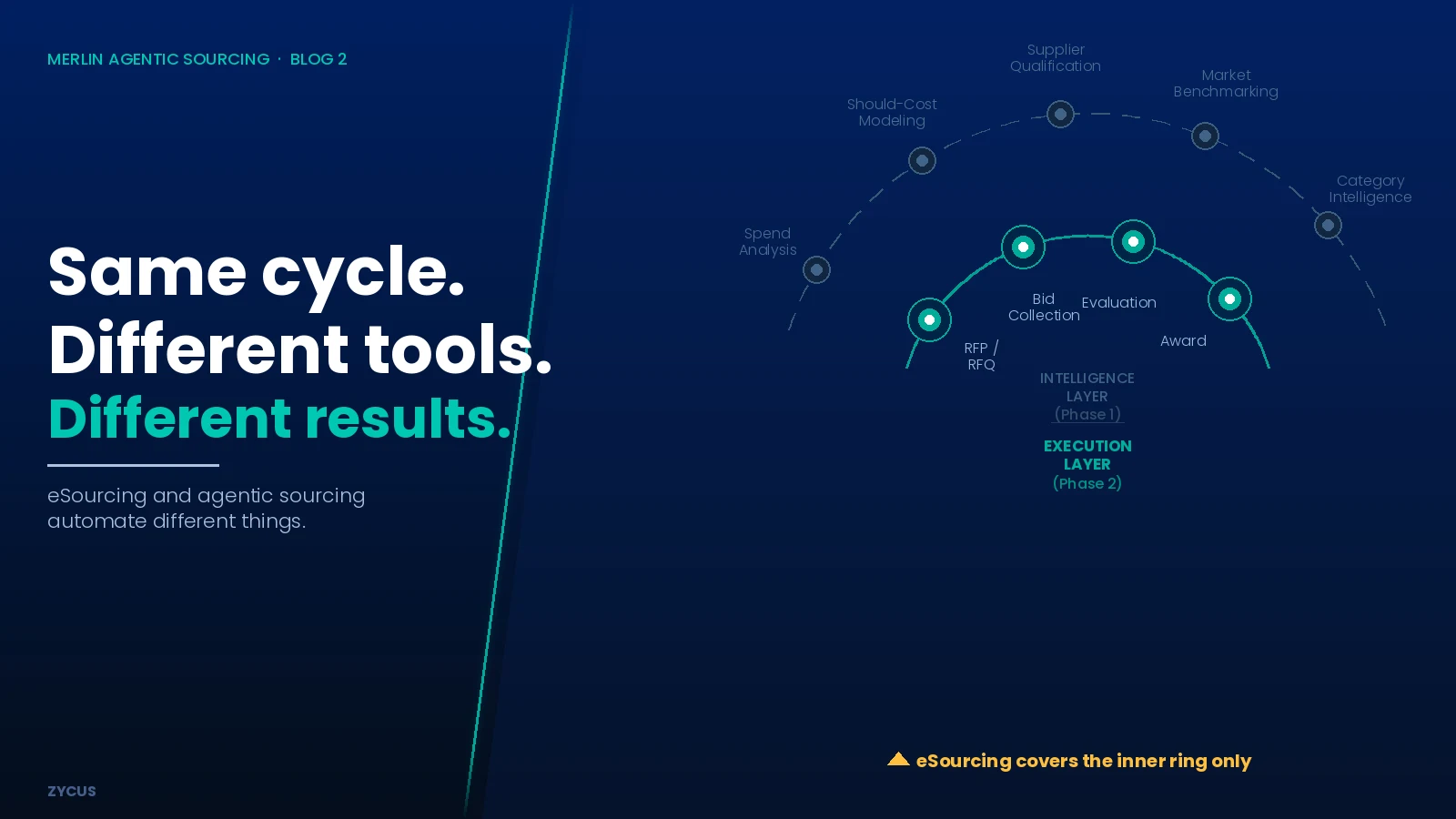
Merlin Agentic Sourcing is designed for decisions where procurement must build an evidence base before approaching suppliers. Its Strategy Flow connects spend and contract analysis, external market benchmarks, should-cost modeling, supplier qualification, approved-vendor requirements, and ESG criteria. The Execution Flow converts that intelligence into category-specific RFP content, compliance gates, supplier communications, and multiple award scenarios.
The important distinction is the role of the human. MAS does not remove the category manager from the decision. It gives the category manager a stronger decision model. Procurement can compare suppliers across price, risk, service, capacity, compliance, and total cost rather than selecting the lowest bid in isolation.
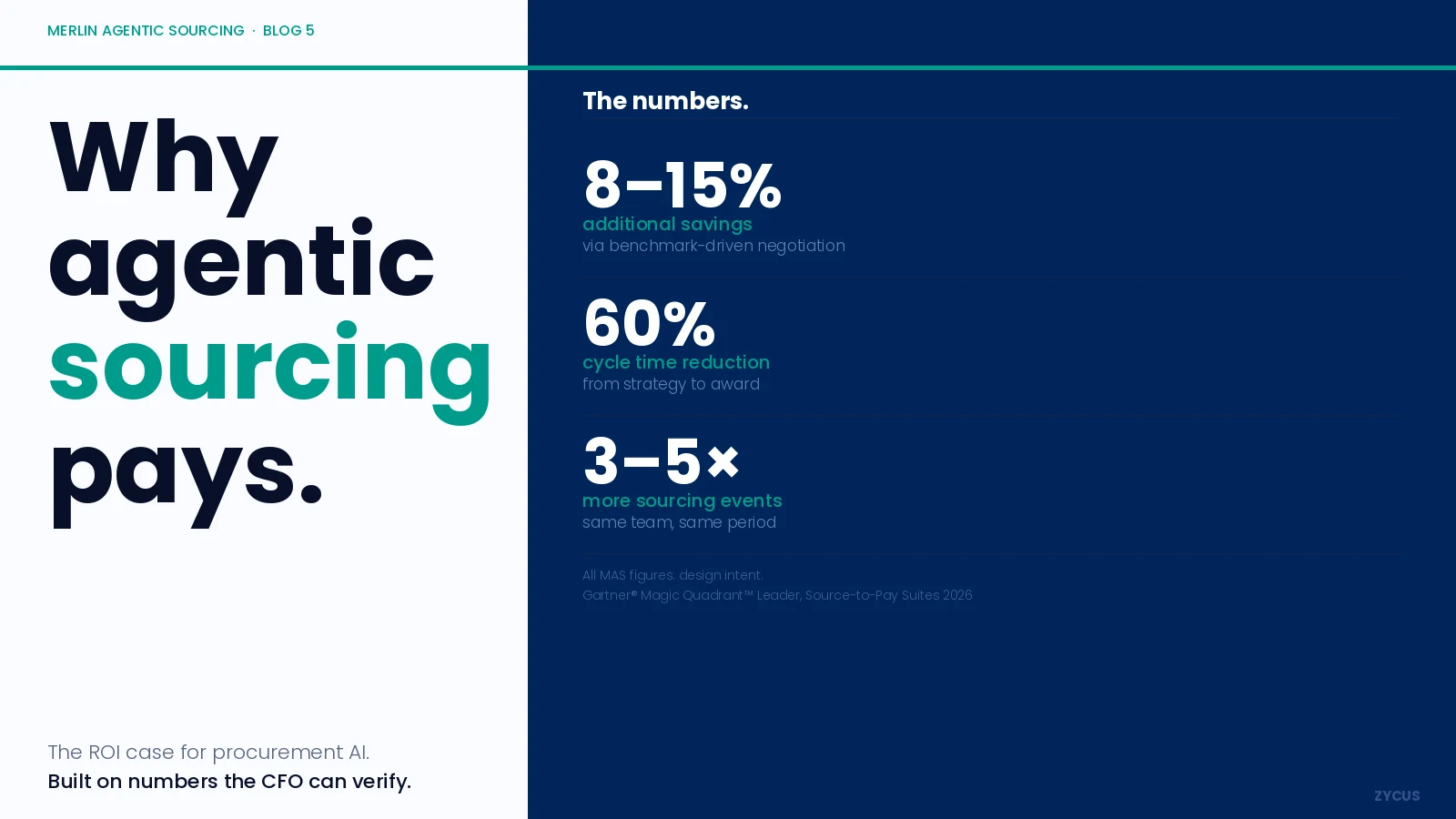
MAS is designed to reduce sourcing cycle time from strategy to award by up to 60%. But cycle time should not be the only measure. Teams should also track the percentage of events using an external benchmark, the value difference between initial bids and the recommended award, category coverage, exception rates, and the time from category intake to a defensible decision.
MAS is most valuable where better intelligence can materially change the commercial outcome.
How Does Autonomous Negotiation Agent Handle the Tail Spend Zone?
The Autonomous Negotiation Agent (ANA) is the third named agent in the Merlin Agentic Platform alongside Merlin Intake and MAS. ANA is purpose-built for the problem MAS is not designed to solve: high-volume, low-risk, routine procurement that requires negotiation at a pace no sourcing team can maintain manually.
A business user identifies a purchase requirement. ANA recognizes the transaction as within the tail spend profile: routine category, low value, available supplier pool. It runs the negotiation autonomously, contacts suppliers, presents the requirement, applies the organization’s pricing parameters and compliance rules, and closes the order. No sourcing professional is needed per transaction. The savings are captured. The user receives what they needed. The sourcing team’s queue does not grow.
ANA operates within the organization’s existing procurement environment, applying compliance rules and preferred supplier agreements without requiring a new interface or replacing existing workflows.
What Falls Through Without Both Agents?
Strategic categories handled without MAS go to market without intelligence. The scope reflects last cycle’s assumptions. The should-cost model is absent or built from prior contract rates. The award is relative rather than anchored. Each gap is measurable in savings left on the table and in cycle time consumed by preparation work the event tool cannot do.
Tail spend unmanaged by ANA takes one of two paths. Either transactions fall outside the procurement process entirely, rogue spend, no compliance tracking, no savings capture, no visibility. Or they land in the sourcing team’s queue, where each small transaction consumes bandwidth that should concentrate on strategic categories. Both outcomes are costly. Neither is necessary.
The two gaps compound each other. When tail spend crowds the sourcing team’s agenda, strategic categories receive fewer intelligence resources, and the portfolio underperforms at both ends.
What Does the Portfolio Look Like When Both Agents Run?
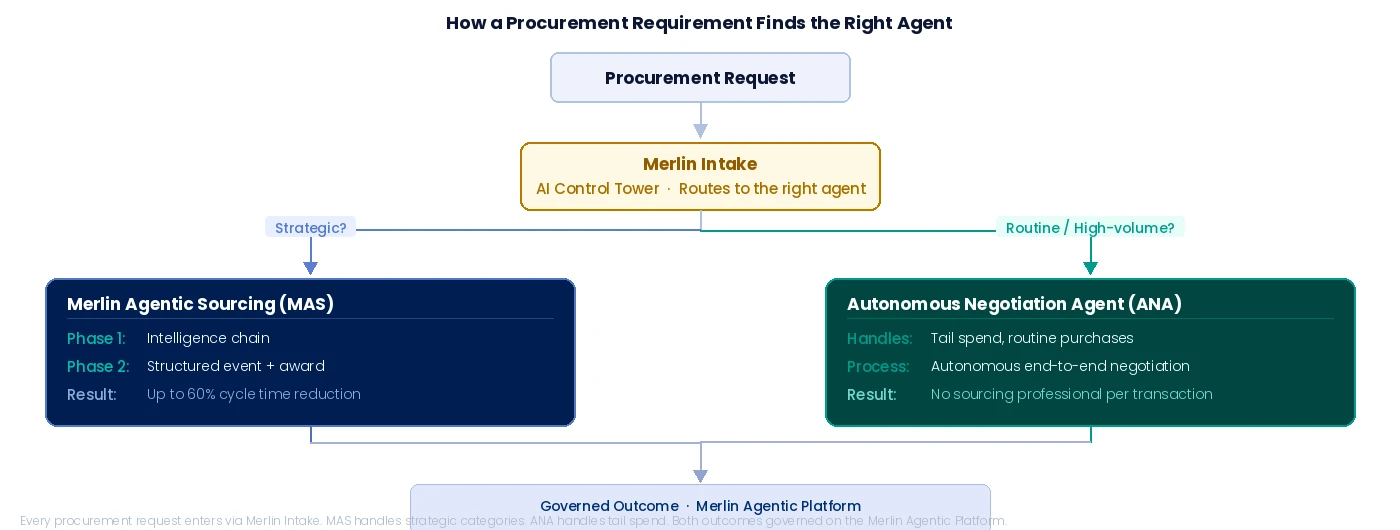
Figure 2: How a procurement requirement finds the right agent. Merlin Intake routes each request. MAS handles strategic categories. ANA handles tail spend. Both outcomes governed on the Merlin Agentic Platform.
Strategic categories: MAS runs the intelligence chain. The sourcing team concentrates where judgment matters, evaluating competing award scenarios, approving recommendations, managing supplier relationships. Cycle time drops. Coverage expands. The same team reaches categories it previously did not have capacity for.
Tail spend: ANA negotiates autonomously. Compliance is maintained. Preferred supplier terms are applied. Savings are captured per transaction. The sourcing team is freed from the queue of small negotiations that previously consumed the same hours as strategic sourcing events.
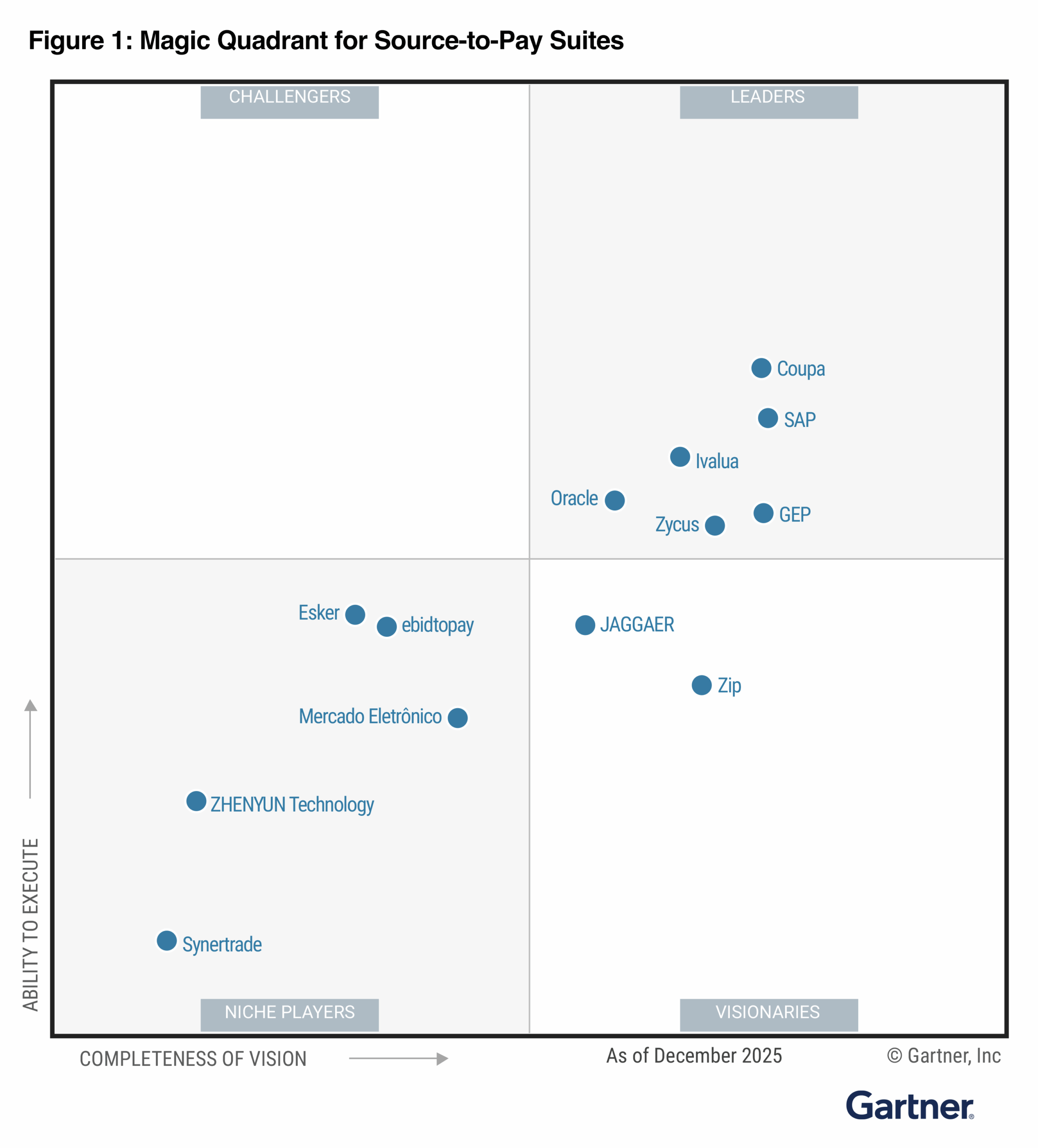
Both agents operate within a single governed architecture: the Merlin Agentic Platform. Zycus was recognized as a Leader in the Gartner® Magic Quadrant™ for Source-to-Pay Suites, January 2026. The Platform connects intake, intelligence, and execution into one governed flow. Every procurement request that enters the flow is routed to the right agent. MAS handles it if the category justifies the intelligence chain. ANA handles it if the category requires autonomous execution. The Intake-to-Outcomes architecture ensures nothing falls through. Bain finds that agentic, autonomous procurement can raise return on investment up to fivefold when it runs across the full portfolio rather than a single category.
How Should Procurement Leaders Map Their Spend to Each Agent?
Three questions identify where each agent belongs.
- Does this category justify a sourcing professional’s full attention per event? If the outcome depends on intelligence and judgment, MAS is the right tool.
- Is this spend repeatable, routine, and high-volume? If autonomous execution is more consistent than manual negotiation for this category, ANA is the right tool.
- What sits at the boundary? Merlin Intake routes each incoming requirement to the correct agent before sourcing work begins. Run this way, the team moves from clearing a queue to the strategic work only judgment can do.
Read More About What Makes an Autonomous Negotiation Agent Truly Intelligent?
See how the Merlin Agentic Platform deploys MAS and ANA across your spend portfolio. One session. Both agents. Published by Zycus. Request a demo →
MAS and ANA are part of the Merlin Agentic Platform, Zycus’s Intake-to-Outcomes architecture for governed, multi-agent procurement.
Frequently Asked Questions
Q1. How do you manage tail spend in procurement without overloading the sourcing team?
To understand how to manage tail spend in procurement, first classify routine, repeatable, and lower-risk purchases before they enter the sourcing queue. Effective tail spend management solutions route eligible transactions to autonomous negotiation while reserving strategic categories for agentic sourcing, category-manager judgment, and human oversight.
Q2. What is the difference between Merlin Agentic Sourcing and the Autonomous Negotiation Agent?
MAS is designed for strategic and complex sourcing categories where the outcome depends on intelligence assembled before the event: spend analysis, should-cost modeling, supplier qualification, and structured RFP authoring. The Autonomous Negotiation Agent (ANA) supports autonomous sourcing for eligible tail-spend transactions, where requirements are routine, lower-risk, and suitable for execution without a sourcing professional managing every negotiation. MAS amplifies the category manager’s intelligence. ANA removes the category manager from the transaction entirely for categories where that is appropriate.
Q3. Which procurement categories should MAS handle?
MAS belongs in strategic and complex categories where the sourcing outcome depends on intelligence and human judgment: direct materials with limited supplier pools, professional services requiring specific qualifications, logistics networks that need lane-level benchmarking, capital equipment with significant compliance requirements, and any category where the quality of the pre-event intelligence materially affects the award. If a sourcing professional’s full attention per event is warranted, MAS is the right tool.
Q4. Which procurement categories should ANA handle?
ANA is designed for routine, high-volume, and lower-risk tail-spend categories. These may include office supplies, low-value maintenance services, routine consumables, one-off purchases outside the strategic catalog, and repeat indirect purchases covered by preferred supplier terms. It complements broader tail spend management solutions by automating negotiations that would otherwise consume sourcing-team capacity.
Q5. Can ANA replace a sourcing professional for tail spend?
For tail spend categories, yes, and that is the design intent. ANA negotiates autonomously, applies the organization’s pricing parameters and compliance rules, and closes the order without requiring sourcing team involvement per transaction. For strategic and complex categories, ANA is not appropriate. The judgment, intelligence, and relationship management that strategic sourcing requires cannot be automated at the transaction level. The line between the two is where the sourcing outcome depends on intelligence versus speed.
Q6. How do MAS and ANA work together on the Merlin Agentic Platform?
They cover different zones of the spend portfolio within a single governed architecture. Strategic categories enter the MAS intelligence chain: spend analysis, should-cost modeling, supplier qualification, and a structured sourcing event. ANA enables autonomous sourcing for eligible tail spend through requirement identification, supplier negotiation, and order closure. Merlin Intake routes each incoming procurement request to the correct agent before work begins. The result is a portfolio where every category is handled by the tool designed for it, with full compliance and governance throughout.
Q7. What is autonomous AI negotiation in procurement, and how does ANA work?
The Autonomous Negotiation Agent (ANA) is the third named agent in the Merlin Agentic Platform alongside Merlin Intake and MAS. It is designed for high-volume, low-risk, routine procurement that requires autonomous negotiation at a pace no sourcing team can match manually. A business user initiates a purchase. ANA identifies the requirement as within the tail spend profile, contacts suppliers, applies pricing parameters and compliance rules, and closes the order without a sourcing professional per transaction. ANA operates within existing procurement environments rather than replacing them.
Related Reads
- Guide to Tail Spend Analysis: What it is and Why it Matters
- How Agentic AI Is Transforming the Source-to-Pay Lifecycle
- Agentic AI vs. Traditional Procurement What Sets Autonomous Procurement Apart
- Streamlining Sourcing: The Power of Autonomous Negotiation
- Autonomous Procurement Agents: The Future Workforce of Digital Enterprises