





The five root causes behind most procurement AI failures are not technical. They are architectural decisions made before the first agent is ever deployed.
TL;DR
- McKinsey’s 2025 State of AI: 88% of organizations use AI, yet nearly two-thirds have not begun scaling it, and just 39% report any enterprise-level EBIT impact.
- When procurement AI disappoints, the instinct is to blame the technology. That diagnosis is almost always wrong. Failure traces to decisions made before deployment begins.
- Two pre-deployment failures account for most programs that stall: delegating the AI agenda too far down the organization, and treating a fast-moving strategic window as something to wait out.
- Two execution failures compound the problem: automating processes that were already broken, and deploying point agents that still require human handoffs between each step.
- The most deceptive failure bolts AI onto existing workflows. It produces results in pilots. It breaks under production complexity.
- Omid Ghamami, President of the Procurement and Supply Chain Management Institute, names all five root causes and the one architectural principle that resolves them. → Watch the APS 2026 session
The Wrong Diagnosis
At the Agentic Procurement Summit 2026, Omid Ghamami opened the series with a challenge to every procurement leader in the room: the story organizations tell themselves about why their AI programs fail is almost never the real story. When a procurement AI program stalls, the post-mortem almost always reaches the same conclusion: the technology was not ready, the timing was wrong, the market had not yet matured. That diagnosis is wrong. Not occasionally. Structurally.
McKinsey’s 2025 State of AI survey found that 88% of organizations use AI in at least one business function. Yet nearly two-thirds have not yet begun scaling AI across the enterprise, and just 39% report any enterprise-level EBIT impact from their investments. The gap is not a technology gap. It is a decision gap.
Ghamami’s diagnostic identifies five decisions that determine whether a procurement AI program delivers or stalls. Each is made before the first agent goes live. Each is architectural. And each looks, in the moment it is being made, like the reasonable choice.
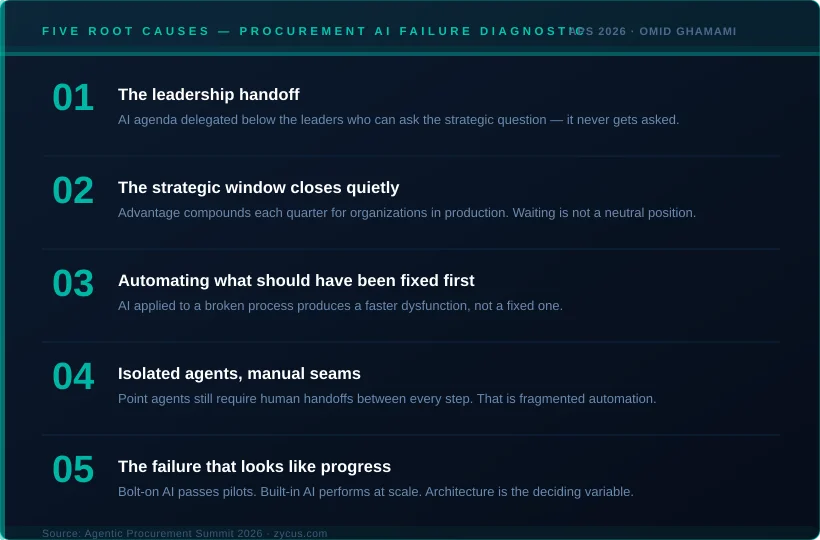
Five root causes: use this as a pre-deployment diagnostic before any agent goes live.
Root Cause 1: The Leadership Handoff
The sequence is familiar. Senior leadership evaluates an AI platform, approves a pilot, and moves the initiative forward. Almost immediately, it also moves down. It lands with teams further into the organization, with managers who are already running at capacity and who may view the deployment as a direct threat to their roles.
The feedback that surfaces is tactical: interface preferences, field adjustments, edge-case objections. Sincere. Not strategic. The enterprise transformation question, how this platform changes what procurement is capable of at scale, has no owner. The leaders who could answer it have delegated to teams whose daily reality makes that question impossible to prioritize.
This is a governance architecture failure. The Hackett Group’s Agentic AI in Procurement Adoption Index 2026 found that 58% of organizations have IT, not procurement, leading the agentic AI strategy. It is a related symptom of the same underlying condition: the leaders who should own the agenda are not holding it.
Root Cause 2: The Strategic Window Closes Quietly
In most technology decisions, patience is rational. Waiting for a market to stabilize, for early adopters to absorb the learning cost, for best practices to crystallize has historically been a defensible approach. Agentic AI is the exception, not because urgency is desirable in itself, but because the advantage compounds.
McKinsey’s 2025 State of AI found roughly 6% of organizations qualify as AI high performers reporting significant EBIT impact, while 94% report little or none. That gap is widening. Organizations waiting for certainty are ceding compounding ground.
Root Cause 3: Automating What Should Have Been Fixed First
The temptation is understandable. A sourcing process that takes three weeks can be compressed to three days with AI applied on top. The result is visible, measurable, and easy to present to leadership.
The problem is that the process being accelerated was broken before the AI arrived. Redundant approvals, unclear routing, inconsistent policy application: none of that disappears when AI is placed over it. It moves faster. A slow dysfunction becomes a fast one.
Deloitte’s State of AI in the Enterprise found that 37% of organizations are deploying AI with little or no change to their existing processes. The corrective requires one disciplined step before deployment: redesign the process. Eliminate unnecessary approvals, minimize handoffs, then automate a lean process. Automating dysfunction accelerates the dysfunction.
Root Cause 4: Isolated Agents, Manual Seams
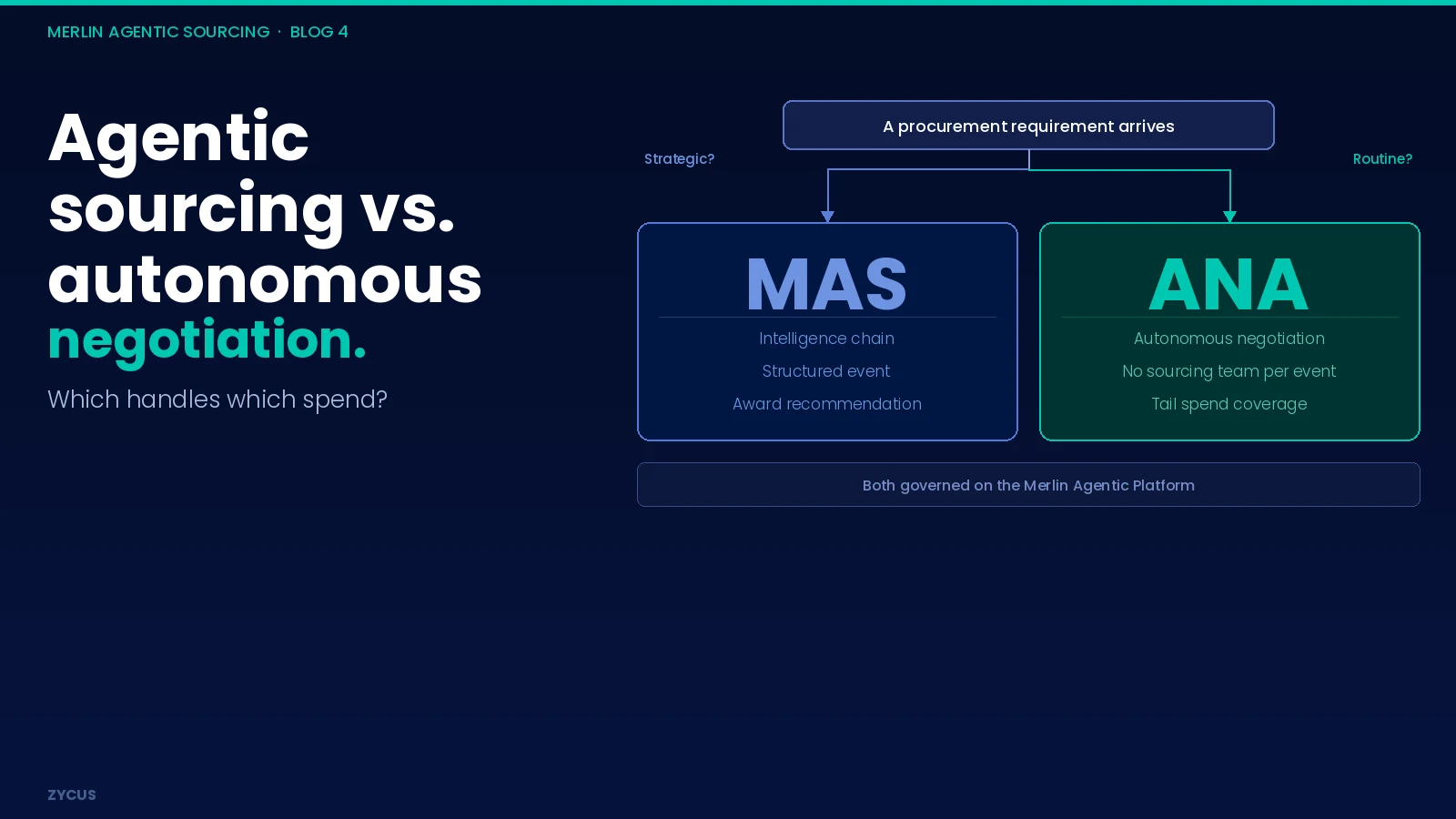
A point agent demo is almost always compelling. An intake agent classifies and routes requests intelligently. A sourcing agent structures events and identifies suppliers. A negotiation agent conducts supplier conversations autonomously. Each capability is genuine.
The problem is the space between them. Between the intake agent and the sourcing agent, there is a human decision. Between sourcing and negotiation, another. The AI advises at each stage while humans stitch the stages together. That is not a transformation. It is fragmented automation with better components.
The Hackett Group’s Adoption Index found that 65% of procurement leaders prefer orchestrated agentic workflows over point agents. That preference reflects a practical understanding: end-to-end flow is the unit of value, not individual agent performance. Whether agents hand off to agents or hand off to people is the architectural decision that separates meaningful transformation from sophisticated task automation.
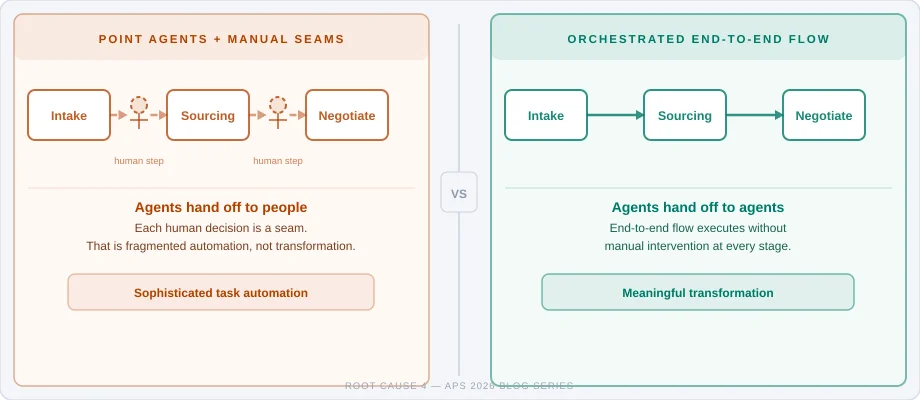 Point agents with manual seams between every step. Right: orchestrated end-to-end flow where agents hand off to agents.
Root cause 5: the failure that looks like progress
Of the five root causes, this is the most dangerous. It is the only one that passes the pilot.
Bolting AI onto an existing workflow is the default path for most deployments. It is faster, simpler to justify, and produces visible results in controlled conditions. The AI layer operates on top of existing systems, automating specific steps within workflows designed before the AI existed.
Pilots work because scenarios are bounded and edge cases anticipated. At scale, edge cases arrive in volume. The AI operates with limited visibility into the data, policies, and process logic beneath its reasoning. When it fails at scale, the diagnosis is usually wrong: the architecture was the problem, not the technology.
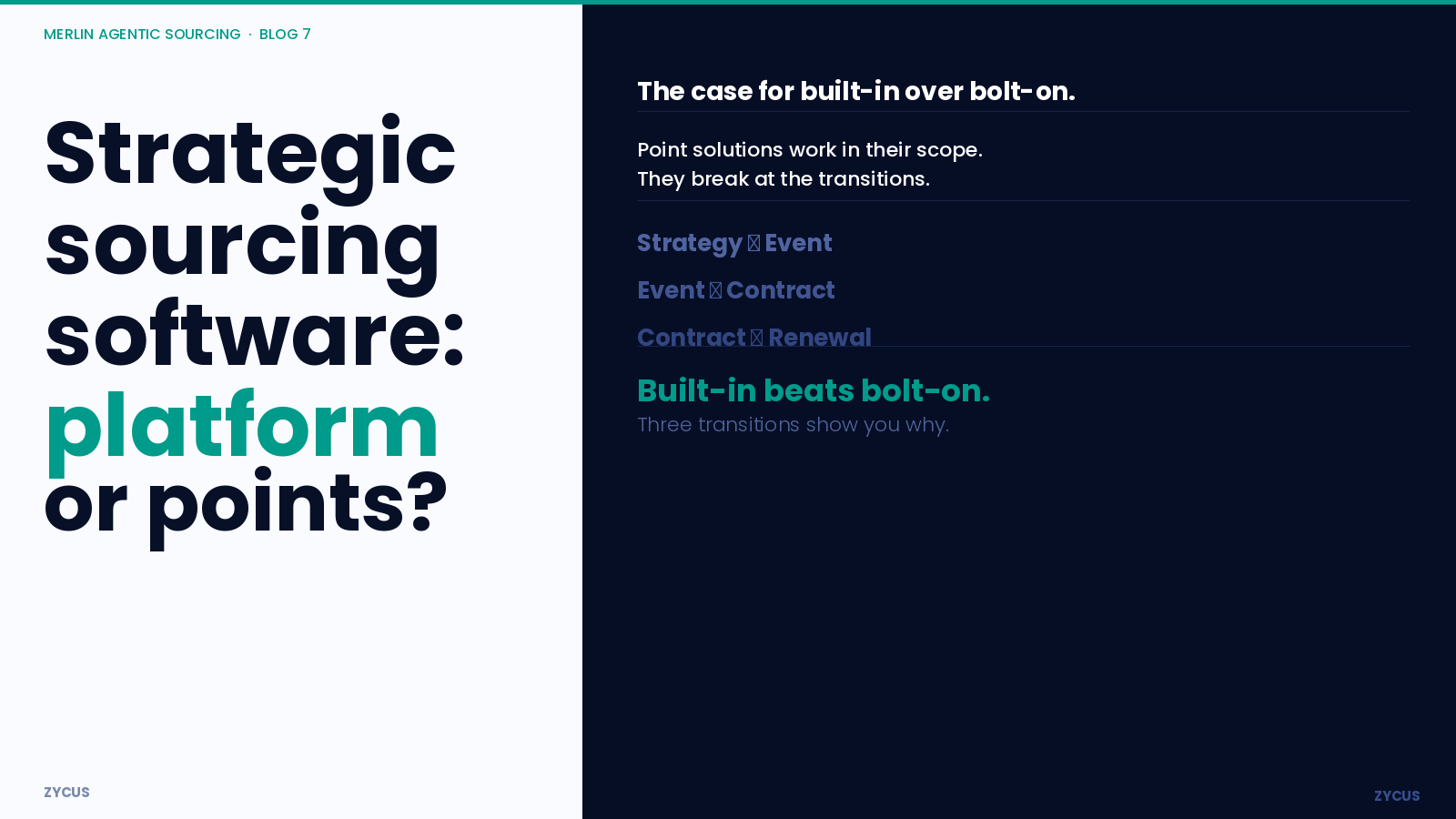
Built-in beats bolt-on, not as a vendor claim but as the foundational architectural requirement for any AI system that has to reason correctly in production. This is the principle Ghamami argues is the single architectural decision that resolves all five failure modes.
What the Organizations Getting it Right Actually Do
The mirror of each failure mode is a specific decision the successful organizations made differently.
At APS 2026, Ghamami described the pattern directly: organizations getting this right have leadership that owns the initiative personally, stays engaged through execution, and keeps focus on enterprise transformation rather than interface-level feedback.
Those organizations moved before the market gave them certainty. They redesigned processes before deploying AI, eliminating unnecessary controls and minimizing handoffs. They built end-to-end flows where agents hand off to agents rather than to people, on platforms where AI is native to the architecture rather than applied over it.
The pattern is not new. In 1998, Ghamami was among the first practitioners in the world to implement e-purchasing at Intel. The organizations that waited for certainty in that wave spent five years catching up. The technology has changed. The compounding dynamic has not.
The Decision Point
The five root causes above work two ways. The first is as a post-mortem on programs that have already stalled. The second, more productive, is as a pre-deployment diagnostic: a five-part check for evaluating, before a single agent goes live, whether the foundational decisions have been made correctly.
The organizations whose agentic AI investments compound over the next two years will not be the ones with the most advanced technology. They will be the ones that made the right five decisions before the first deployment began.
The next session at APS 2026 reframed the question: not why agentic AI fails, but what agentic AI actually is, and why most procurement teams are building the wrong version. → Copilots Answer Questions. Agents Achieve Outcomes. Procurement Needs to Know the Difference.
Agentic Procurement Summit 2026 — On-Demand Access. Omid Ghamami, President, Procurement and Supply Chain Management Institute, presents the full session alongside research from The Hackett Group and Forrester. Sponsored by Zycus. → Access the full session
Next blog in the series: Copilots Answer Questions. Agents Achieve Outcomes. Procurement Needs to Know the Difference
FAQs
Q1. How do we know if our AI program has a leadership handoff problem?
If feedback reaching leadership is about interface preferences rather than enterprise outcomes, the initiative has moved too far down. The leaders who should own it have delegated to teams who cannot answer the transformation question.
Q2. We have already deployed AI agents. Can we fix a bolt-on architecture after the fact?
Yes, but treat it as a separate redesign project. Identify historical handoffs, eliminate unnecessary approvals, and define a lean process before adding more capability on top.
Q3. Our pilots showed strong results but production has stalled. What is the most likely cause?
Root Cause 5. Pilots work in bounded conditions; production exposes everything the pilot anticipated away. An AI layer outside the architecture hits every seam where data and policy context are inaccessible.
Q4. How do we run the five-part diagnostic before our next deployment?
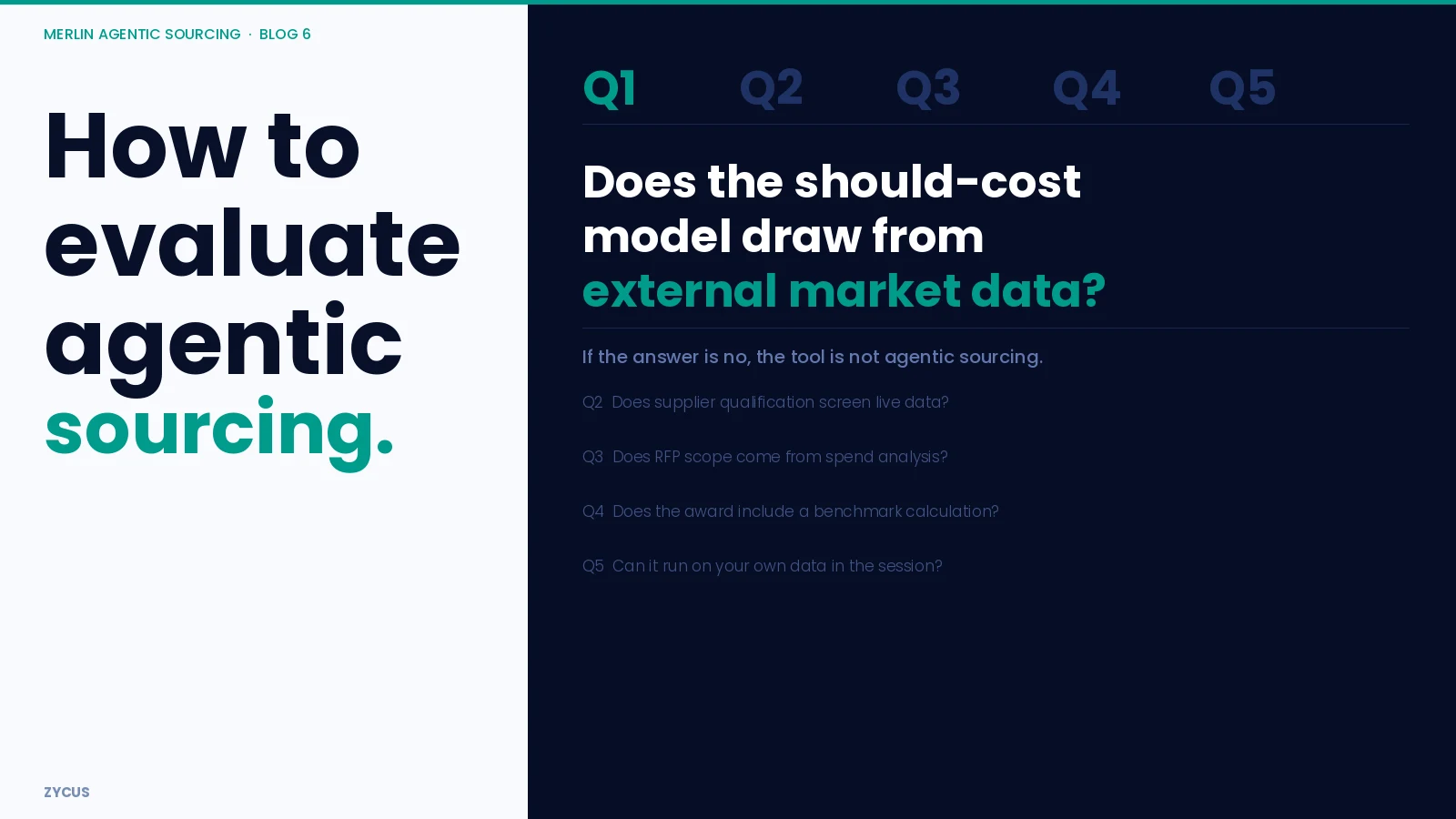
Evaluate each root cause as yes or no before any agent goes live: leadership ownership, timing commitment, process redesign, end-to-end flow design, built-in versus bolt-on. A no on any item is a deployment risk.
Q5. What is the fastest path from isolated agents to orchestrated flows?
The constraint is governance, not technology. Organizations that make the architecture decision explicitly and assign clear ownership typically reach production scale in 12 to 18 months. Pilot-only programs take the same time and stall.
Q6. Where should we start if we cannot address all five root causes simultaneously?
Root Cause 1. If leadership does not personally own the initiative, no one below them can answer the enterprise transformation question. Everything else depends on this being resolved first.
Related Reads: