





For large organizations managing complex global supply chains, fragmented purchasing and hidden spend leakage can severely undermine financial performance. To eliminate bottlenecks and gain total operational clarity, enterprise leaders are increasingly turning to the best source-to-pay platforms for enterprise procurement. Evaluating the top source-to-pay software platforms requires looking beyond basic automation to find solutions that deliver best source-to-pay platforms for full procurement visibility, ensuring every dollar from initial sourcing down to final invoice reconciliation is tracked and optimized.
The six platforms Gartner named Leaders in 2026, what separates them for large and complex enterprises, and how to choose the right fit.
TL;DR
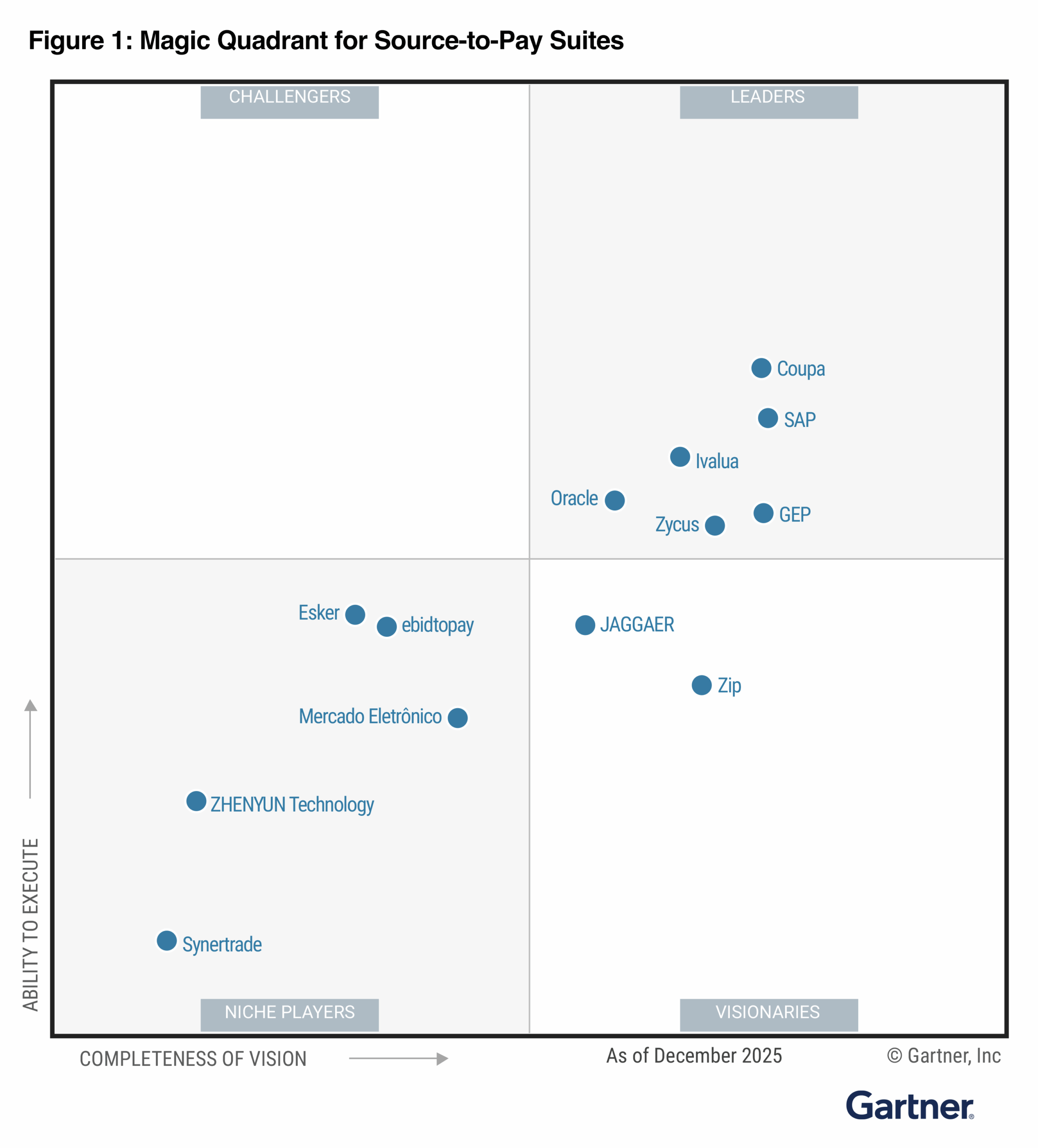
- Gartner evaluated 13 source-to-pay vendors in its January 2026 Magic Quadrant and named six Leaders: Coupa, GEP, Ivalua, Oracle, SAP, and Zycus.
- The decision is less about which platform is best in the abstract and more about which fits your spend profile, ERP landscape, governance needs, and agentic roadmap.
- Enterprise-grade source-to-pay rests on five capabilities: end-to-end orchestration, a unified data model, supplier and risk management, governance and control, and ERP integration.
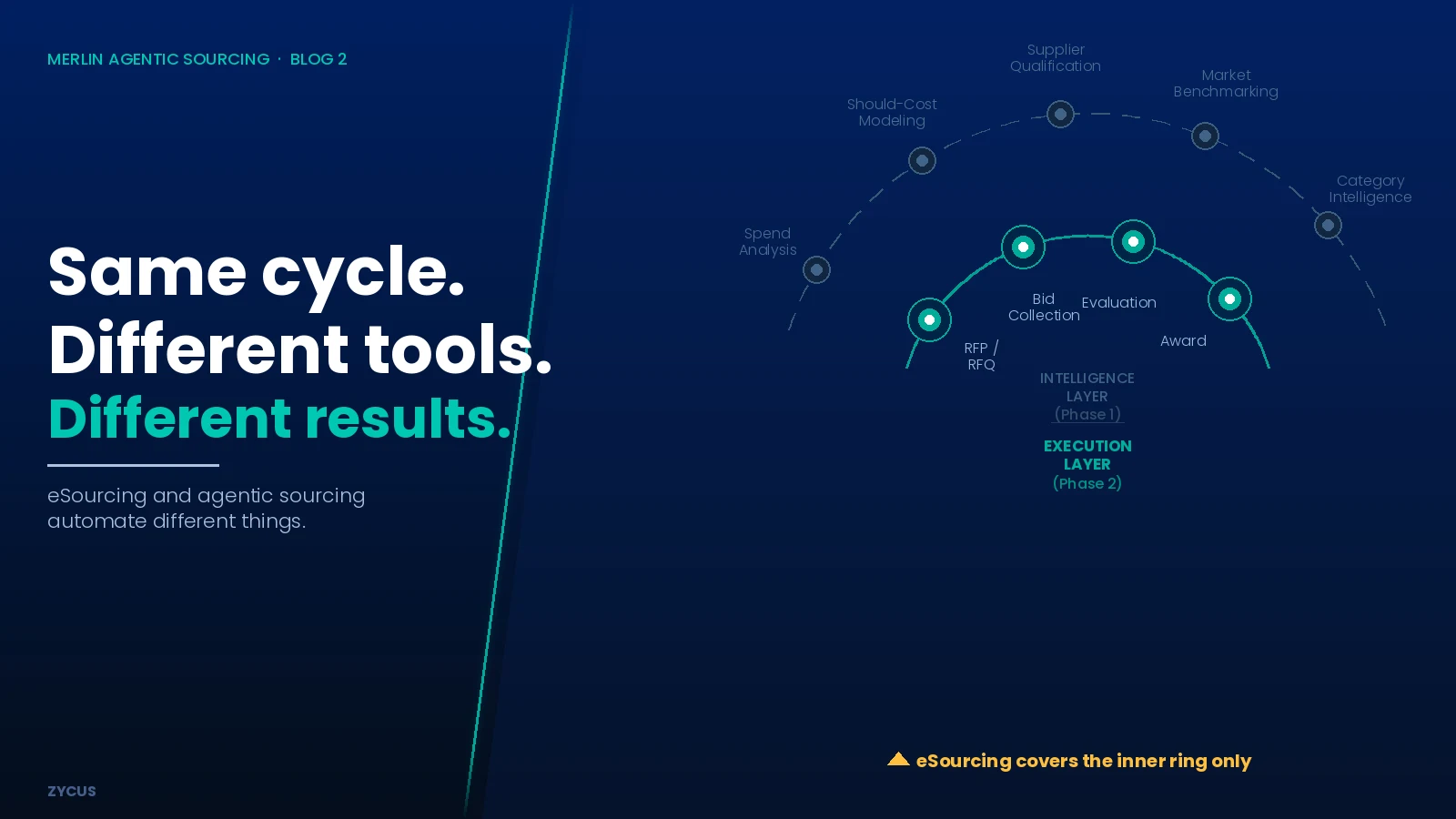
- The market is shifting from software that records to software that acts. Gartner expects agentic AI features in 60% of enterprises using supply chain software by 2030, up from 5% today.
- Architecture, not feature count, separates the Leaders, and top-quartile teams deliver 2.6X greater ROI at 19% lower cost as a share of spend (Hackett Group, 2025).
- Compare the full strengths and cautions for every Leader in the 2026 Gartner Magic Quadrant for Source-to-Pay Suites.
How we built this list
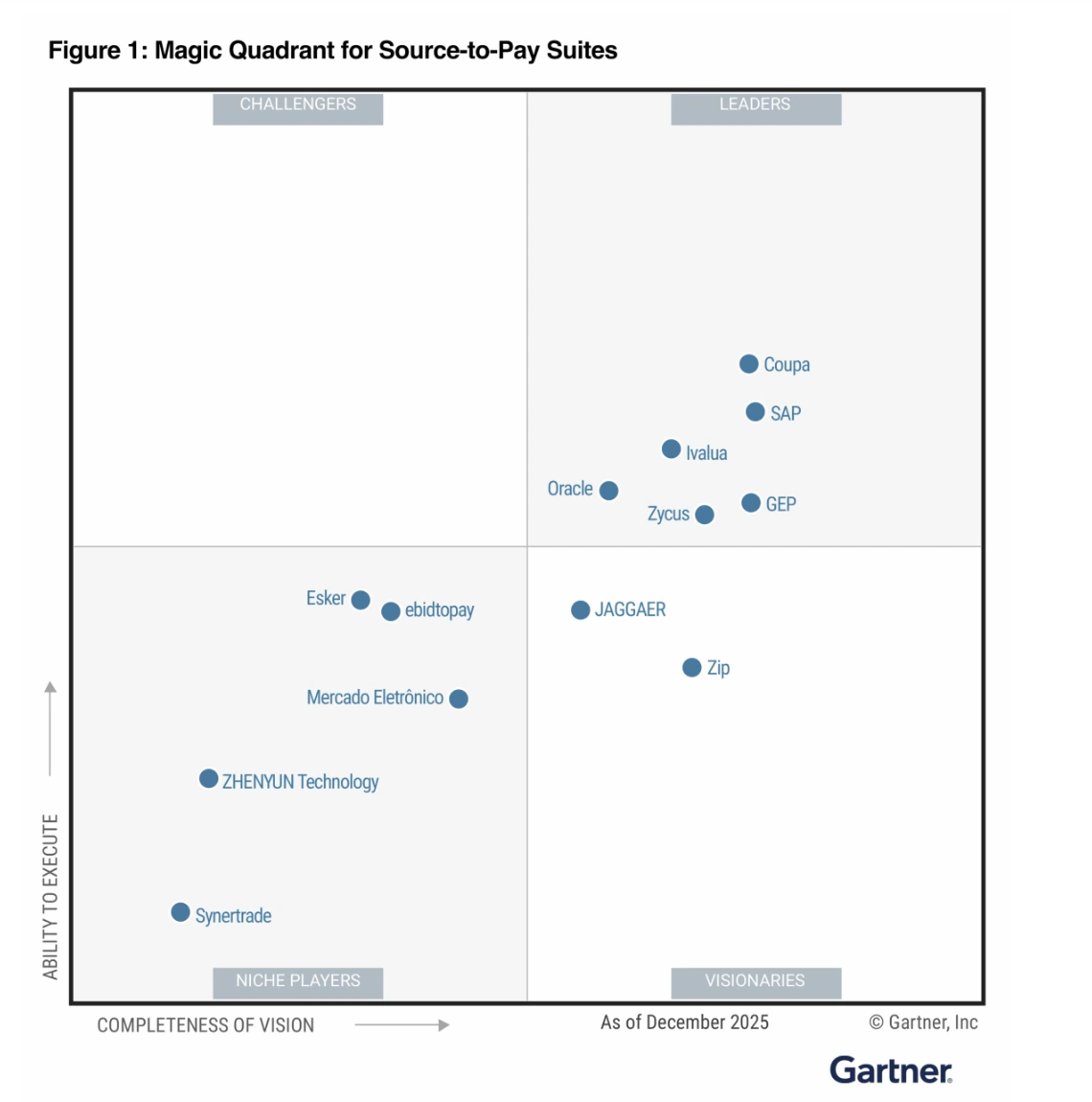
Selection basis – We included the six vendors Gartner named Leaders in the 2026 Gartner® Magic Quadrant™ for Source-to-Pay Suites, published 21 January 2026, which evaluated 13 providers on Ability to Execute and Completeness of Vision. We did not add or remove vendors based on our own view of the market.
How we profiled each one – We assessed all six against the same five enterprise capabilities used throughout this article: end-to-end orchestration, a unified data model with real-time analytics, supplier management and risk visibility, governance and control, and ERP integration. Profiles draw on Gartner’s published positioning, each vendor’s own product documentation, and publicly available customer review data from Gartner Peer Insights and G2.
What makes a source-to-pay platform enterprise-grade?
At enterprise scale, a platform earns its place on five capabilities, not on a feature checklist: end-to-end orchestration, a unified data model with real-time analytics, supplier management and risk visibility, governance and control, and ERP integration. The bar is also rising. Gartner forecasts that supply chain software with agentic AI will grow to $53 billion in spend by 2030, from under $2 billion in 2025, and that 60% of enterprises will adopt agentic features by 2030, up from 5% today. The sections below define each capability and how to judge whether a platform delivers it at scale.
What does end-to-end orchestration actually connect?
The first test is whether the platform connects the full cycle, from requisition and approval through purchase order, receipt, invoice, and payment, into one continuous flow rather than a set of automated islands. Duplicate payments, human matching, and bottlenecks are caused by partial automation. The financial gap is measurable: Ardent Partners’ State of ePayables 2025 research finds best-in-class accounts payable teams process an invoice for about $2.78, against roughly $10.89 for average performers, a 74% gap. Platforms built this way, such as the Merlin Agentic Platform, run it as governed, multi-agent flow across one suite that has processed $1Tr+ in spend globally.
Why does a unified data model matter more than analytics features?
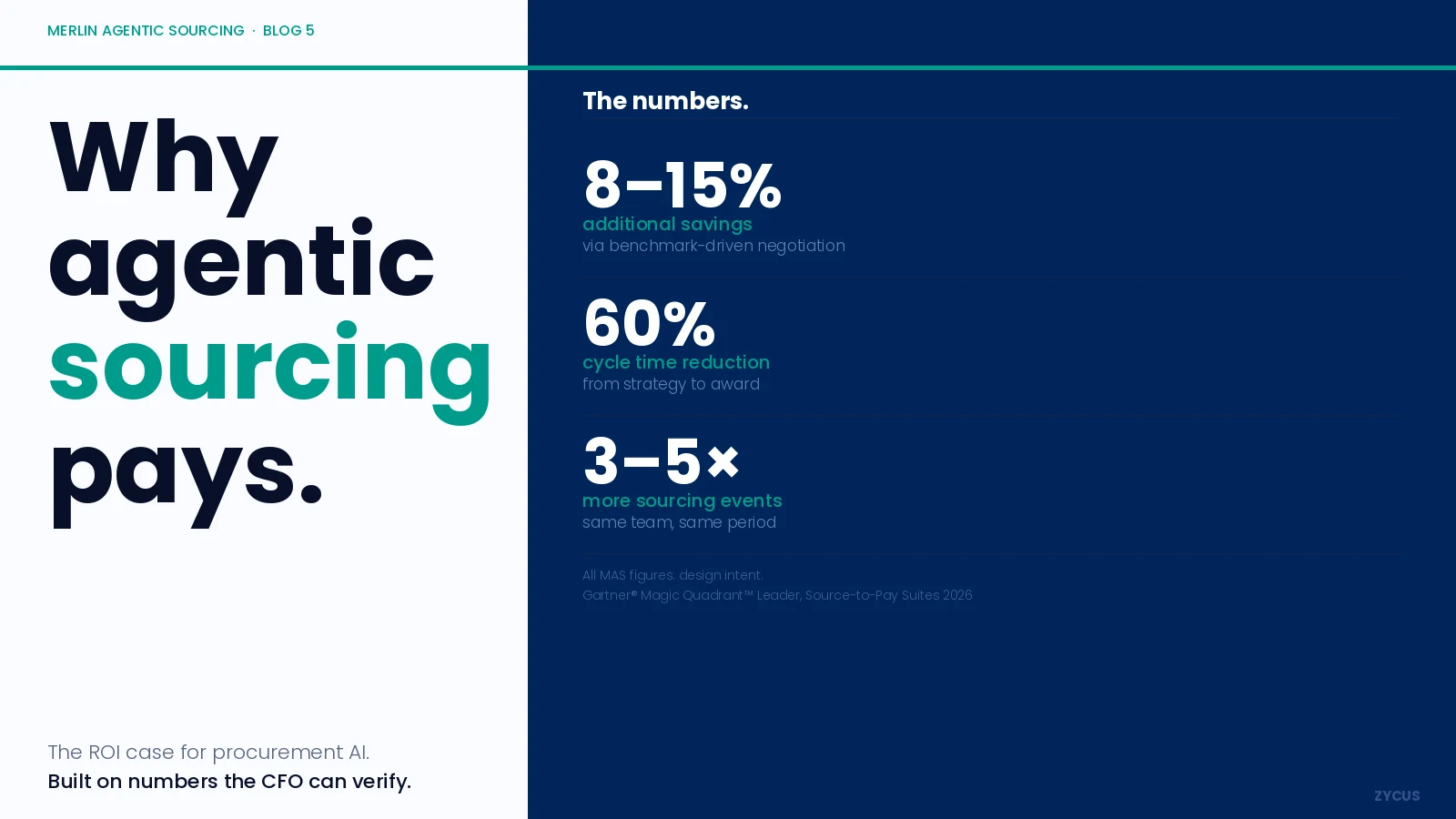
A platform is only as intelligent as its data model. When sourcing, contracts, procurement, and payment share one model, AI can surface spend anomalies, off-contract buying, and savings without manual reconciliation. Accuracy is lost when analytics are grafted onto different systems. This is where autonomous agents earn their place: Zycus reports that its Autonomous Negotiation Agent (ANA) delivers 2–7% cost savings on competitively sourced transactions and a 30–60% productivity improvement for tactical buying teams, based on Zycus customer deployment data.
How should an enterprise platform handle supplier management and risk?
A large enterprise manages thousands of suppliers across regions and tiers. The platform should onboard, qualify, monitor, and score them in one place, with risk visible before it becomes disruption. Self-service portals, automated document collection, and performance dashboards separate platforms built for enterprise supplier bases from those retrofitted for them.
Where should governance and control sit in a source-to-pay platform?
Enterprise procurement cannot trade control for automation. Policy, approval, and audit have to be enforced as spend moves, not reconstructed afterward. The test is where control lives. A platform that checks an approval threshold at the moment of requisition behaves differently from one that flags the breach in next month’s audit. With each transaction, the gap between AI and the governance layer grows.
How deeply should source-to-pay integrate with SAP and Oracle ERP?
Procurement cannot operate in isolation from finance and operations. The platform must connect to SAP, Oracle, and other systems through pre-built connectors, real-time synchronization, and open APIs, or it becomes another silo. Integration depth shapes total cost of ownership more than any single feature. Platforms with a deep integration surface move data from requisition to payment without manual reconciliation. Zycus states that its Merlin Agentic AI Platform exposes 1,121 APIs for enterprise integration.
What does the Gartner Magic Quadrant for source-to-pay actually measure?
Before reading the quadrant, know what it scores. Gartner rates vendors on two axes: Ability to Execute, proven delivery today, and Completeness of Vision, direction, increasingly defined by agentic capability. Leaders score high on both. For a large enterprise the pairing matters, because a platform strong on delivery can still trail on the vision that shapes the next five years.
Which platforms are the 2026 leaders in source-to-pay?
The most widely recognized independent benchmark is the Gartner Magic Quadrant for Source-to-Pay Suites, scored on Ability to Execute and Completeness of Vision. In its January 2026 edition, Gartner evaluated 13 providers and named six Leaders. Each takes a distinct approach:
- Coupa is recognized for spend management and a large business network, and fits indirect-spend programs that prioritize fast adoption.
- GEP pairs procurement software with consulting services, fitting advisory-led transformation programs that want bundled support.
- Ivalua is recognized for a configurable, unified platform, fitting sourcing-intensive programs with direct-spend depth.
- Oracle embeds procurement inside its cloud ERP suite, fitting finance-led, Oracle-standardized enterprises.
- SAP leverages its ERP ecosystem and business network, fitting SAP-standardized global enterprises.
- Zycus is recognized for agentic AI built into a unified suite, fitting complex global enterprises moving from Source-to-Pay to Intake-to-Outcomes.
At a glance:
| Platform | Recognized for | Best fit | Weakest fit | Deployment and ERP posture | Pricing model |
|---|---|---|---|---|---|
| Coupa | 2026 MQ Leader, positioned highest for Ability to Execute for the third consecutive year; total spend management breadth and a large business network | Indirect-spend programs wanting fast adoption and community benchmarking across many countries | Reviewer themes on G2 and Peer Insights consistently cite long implementation timelines and a heavy interface for occasional requesters | Cloud SaaS, ERP-agnostic; typically requires middleware for SAP; strong fit with Oracle, Workday, Microsoft Dynamics | Quote-only, modular; no published list pricing |
| GEP | 2026 MQ Leader for the second consecutive year; software paired with consulting services, unified direct and indirect coverage | Advisory-led transformation programs that want software and services from one provider | Enterprise-weight and services-led; a smaller independent review base than Coupa or SAP Ariba, so less public reviewer evidence to evaluate | Cloud-native; integrates with SAP S/4HANA, SAP ECC, Oracle Fusion, Oracle E-Business Suite, Workday | Quote-only, scope-based; no published list pricing |
| Ivalua | 2026 MQ Leader; configurability, a single data model, and direct-materials depth | Sourcing-intensive programs needing deep configuration without custom code, and strong direct-materials coverage | Reviewers repeatedly cite a configuration learning curve and training as the main adoption barrier; professional-services cost is a real TCO line | Cloud, ERP-neutral with bi-directional sync; supports SAP and Oracle, middleware typical for SAP | Hybrid: per-module subscription plus spend-under-management and user licensing; custom quote |
| Oracle | 2026 MQ Leader; embedded AI and analytics native to Oracle Fusion | Finance-led enterprises already standardized on Oracle Fusion, needing tight ERP, HCM and CPQ integration | Independent roundups consistently describe the value as strongest inside an Oracle landscape; less compelling for mixed or non-Oracle estates | Cloud, native to Oracle Fusion ERP | Quote-only enterprise pricing |
| SAP Ariba | 2026 MQ Leader; enterprise breadth, the largest supplier business network, native SAP integration | SAP-standardized global enterprises with large supplier bases and complex global sourcing | Reviewer themes cite implementation complexity and a heavy interface that suppresses casual-user adoption, which can push spend off-platform | Cloud, native for SAP S/4HANA and ECC; open APIs for third-party ERP | Quote-only, modular; no published list pricing |
| Zycus | 2026 MQ Leader; agentic AI built natively into a single unified suite, taking enterprises from Source-to-Pay to Intake-to-Outcomes | Complex global enterprises that want autonomous agents operating inside the governance layer rather than beside it, on one data model built organically rather than assembled through acquisition | Supplier-network reach is smaller than SAP Ariba’s or Coupa’s, so network-density-led programs may weigh those higher; enterprises fully standardized on Oracle or SAP ERP that want procurement native to that same stack will find the incumbent a shorter path | Cloud; ERP-agnostic with pre-built connectors for SAP and Oracle; Zycus states 1,121 APIs for integration | Quote-only, module and suite-based; no published list pricing |
All six are Leaders. The useful work is matching a profile to yours, which the next sections help you do.
How should a large enterprise choose among them?
Score the Leaders on four dimensions: spend profile (direct versus indirect balance), ERP landscape (integration depth with finance and operations, which shapes total cost more than any single feature), governance and control (policy, audit, and approval enforced in the flow of work), and configuration versus customization (deep configurability without brittle custom code). Deloitte’s 2025 Global Chief Procurement Officer Survey found that Digital Masters, the top quartile investing in technology and talent, met or exceeded their cost-savings targets 96% of the time, against 80% for followers.
Why does architecture matter more than feature count?
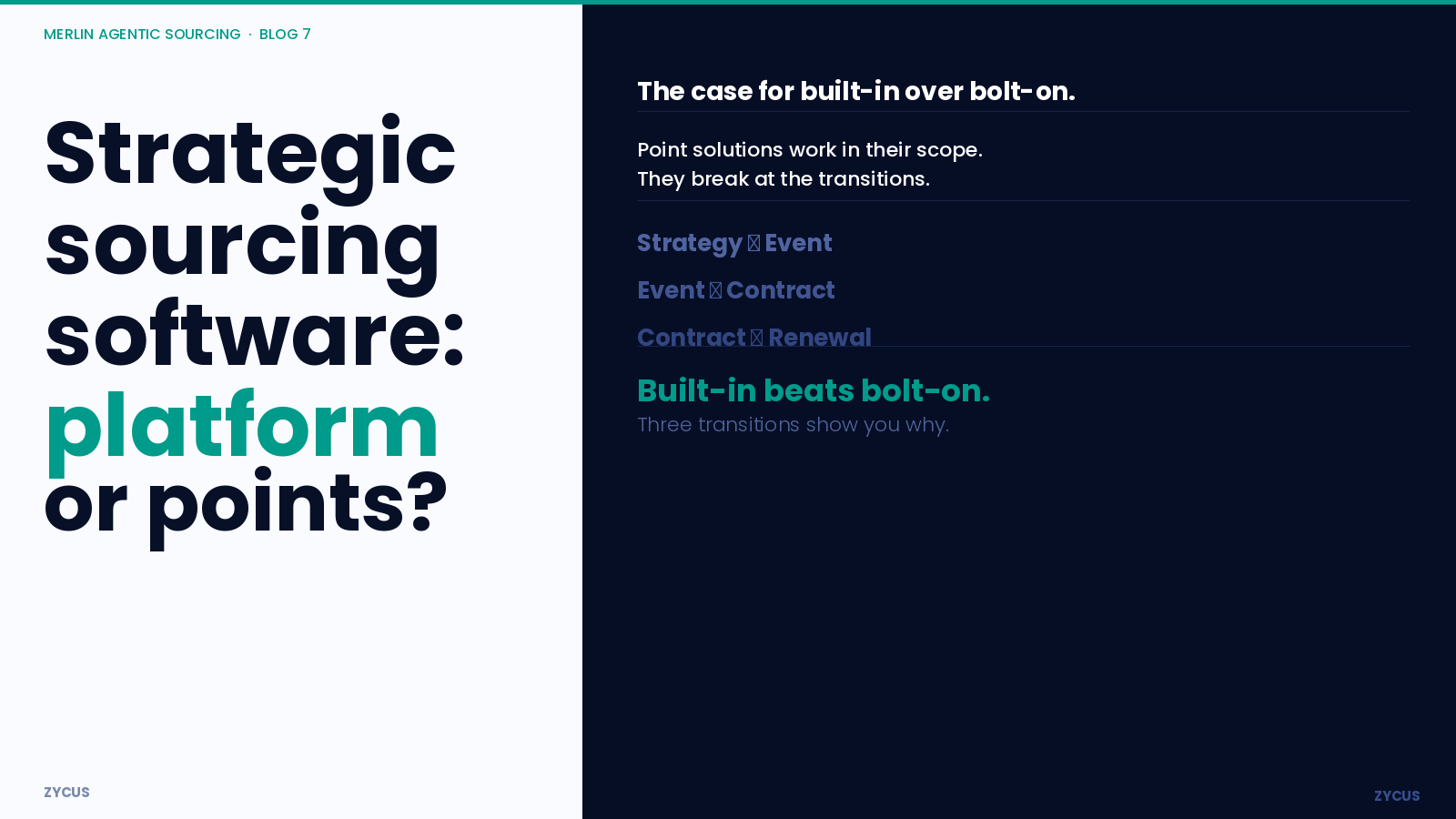
Two platforms can list the same features and behave differently at scale. What separates them is whether the intelligence is structural or added on top. Built-in beats bolt-on: when AI and governance are native to a single data model, a decision made in sourcing is visible at payment, and control does not depend on synchronizing separate tools.
This is a property of how a platform is built, not a verdict on any single vendor. Hackett Group’s 2025 research shows top-quartile, Digital World Class procurement teams deliver 2.6X greater ROI than peers while operating at 19% lower cost as a share of spend, an advantage that compounds where a platform removes handoffs rather than papering over them.
What is the business case for getting this right?
For a large enterprise, the return on a well-chosen platform shows up in three places: process cost falls as orchestration removes rework, savings stick as governance closes the gap between negotiated and realized value, and capacity is freed as agents take routine work. The risk runs the other way, because a platform that does not fit becomes a multi-year program that under-delivers.
Where does Zycus fit for large enterprise teams?
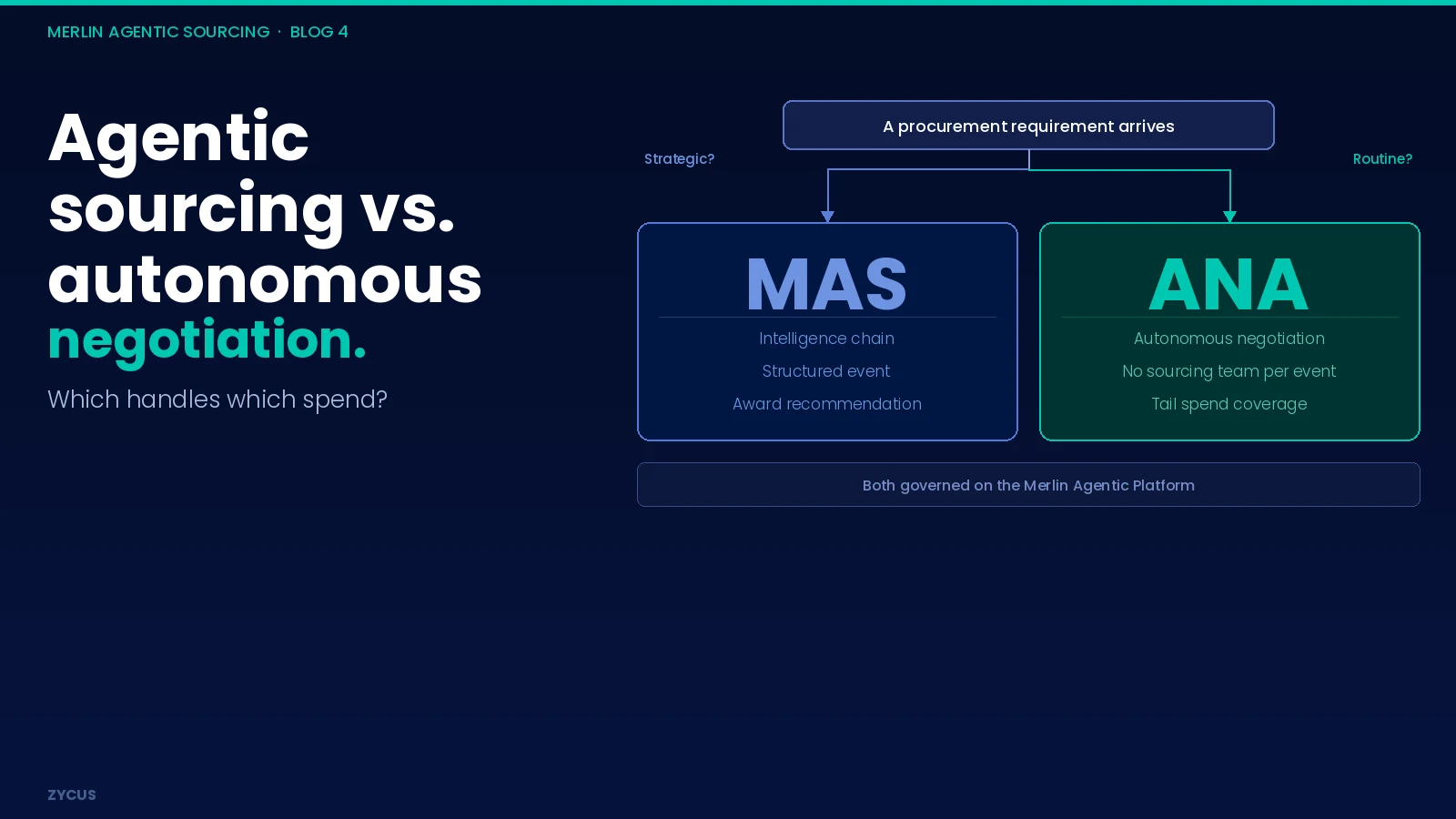
Zycus is built for the enterprise that wants AI inside its governance, not beside it. The Merlin Agentic Platform runs governed, multi-agent flows across one unified suite, taking enterprises from Source-to-Pay to Intake-to-Outcomes. Merlin Intake gives every request a single front door inside the tools people already use, ANA handles tail spend autonomously, and the suite is backed by 32+ patents and $1Tr+ in spend processed globally. The operating principle is simple to state and hard to retrofit: AI decides, the suite governs, the enterprise stays in control. Read against the five capabilities above, that is the profile Zycus is built to fit.
What results have enterprises reported with Zycus?
Published Zycus customer outcomes give a sense of the range at enterprise scale.
- A global electronics manufacturer analyzed $22.6 billion in spend across more than 20 million transactions on the platform.
- A Fortune 500 sustainable fiber-based packaging company reported a 75% reduction in contract cycle time, a five-fold increase in contracts authored, and a 60% increase in sourcing events.
- Belden, a $2.4 billion manufacturer operating in 27 countries, reported cutting PR-to-PO cycle time by 40%.
- BDO Unibank, the largest universal bank in the Philippines, went live on source-to-pay in 12 weeks.
All figures are reported by the customers to Zycus and published as Zycus case studies.
The Hackett Group’s 2026 Procurement Agenda & Key Issues Study, released 17 March 2026, found that 71% of procurement organizations have adopted generative AI at pilot or full-scale, and 56% have deployed agentic AI, both roughly double the prior year, though large-scale deployment remains under 15%.
McKinsey’s October 2025 report Transforming Procurement Functions for an AI-Driven World, based on a survey of more than 300 global procurement leaders, found that AI tools can improve procurement productivity by 25 to 40%, and that procurement teams now manage roughly 50% more spend per employee than five years ago.
What does the analyst recognition actually say?
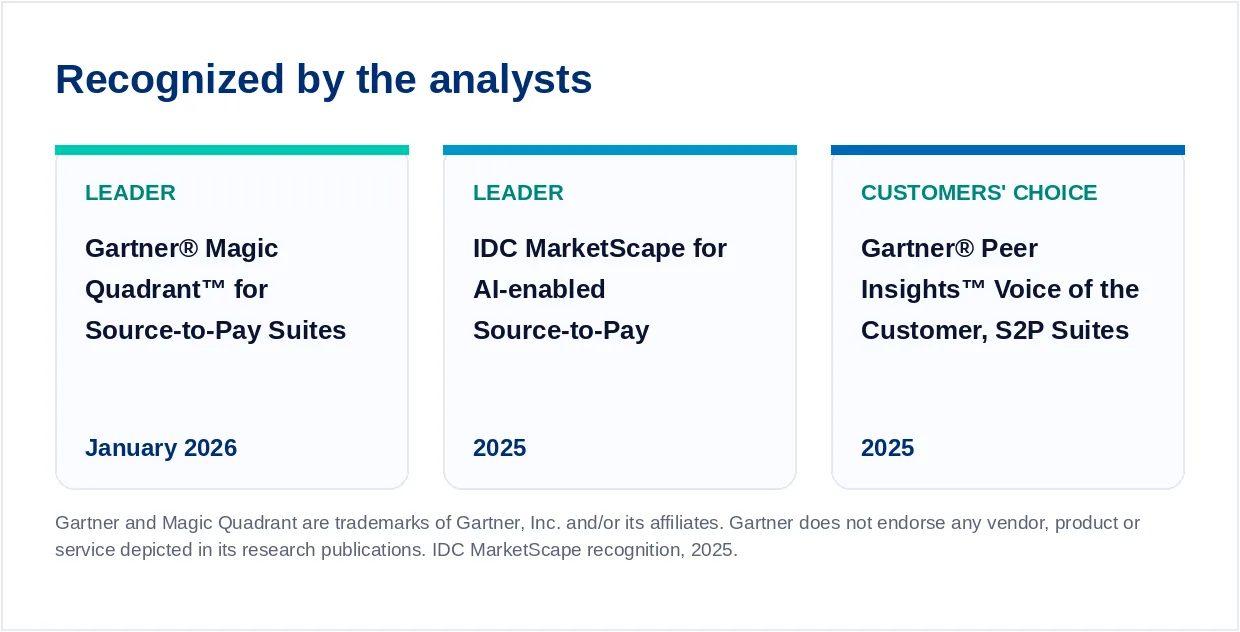
Independent recognition is converging. Zycus was named a Leader in the 2026 Gartner Magic Quadrant for Source-to-Pay Suites, a Leader in the 2025 IDC MarketScape for AI-enabled source-to-pay, and a Customers’ Choice in the 2025 Gartner Peer Insights Voice of the Customer for Source-to-Pay Suites. Analyst evaluation and verified customer reviews pointing the same direction matters more for a multi-year platform decision than any single ranking does on its own.
What are the limits of a best-platforms list?
A quadrant ranks the market. It does not rank your fit. All six Leaders are capable enterprise platforms, and the right choice depends on the spend you run, the systems you keep, and the operating model you want three years from now. Use the list to build a shortlist, then test it against your own scenarios rather than treating position as a verdict.
How do you move from shortlist to decision?
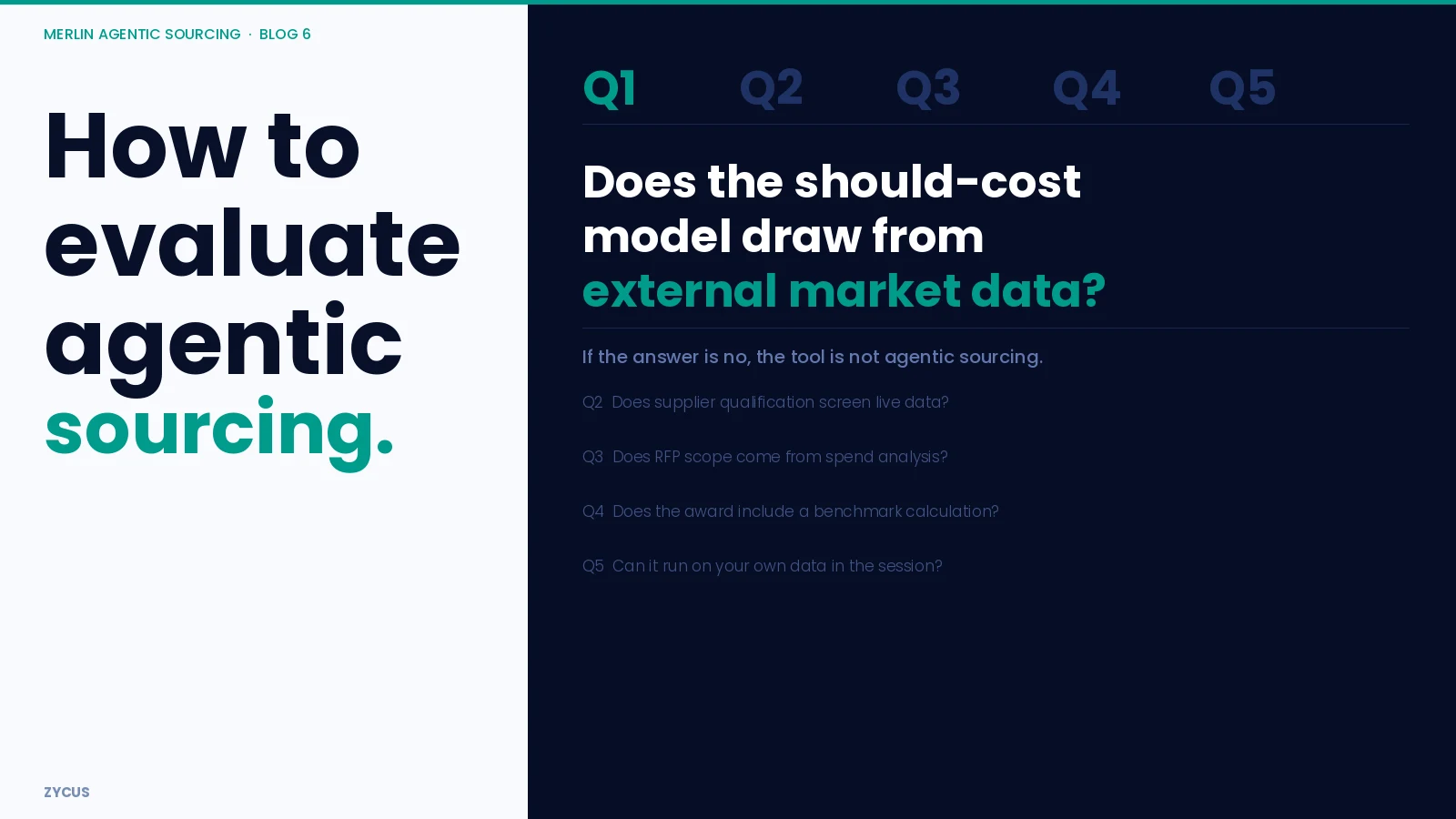
Shortlist the two or three Leaders whose profile fits yours. Run demos against your real scenarios rather than scripted ones. Validate every claim against analyst evaluations and customer references, and compare each platform on the source-to-pay capabilities that matter most to your business.
GET THE REPORT
Read the 2026 Gartner® Magic Quadrant™ for Source-to-Pay Suites to see how all 13 vendors were evaluated on Ability to Execute and Completeness of Vision, and why Zycus is positioned in the Leaders quadrant. Published by Zycus.
Gartner, Magic Quadrant for Source-to-Pay Suites, Micky Keck, Magnus Bergfors, Kaitlynn Sommers, Alex Brady, Lynne Phelan, 21 January 2026. Gartner and Magic Quadrant are trademarks of Gartner, Inc. and/or its affiliates. Gartner does not endorse any vendor, product or service depicted in its research publications, and does not advise technology users to select only those vendors with the highest ratings or other designation.
Choosing the right technology infrastructure is a defining decision for modern supply chain leaders aiming to scale operations efficiently. By integrating the best source-to-pay platforms for procurement teams, enterprises can replace siloed workflows with unified intelligence and control. Ultimately, investing in the best source-to-pay platforms for full procurement visibility ensures that your organization not only streamlines day-to-day transaction processing but also unlocks long-term strategic value across the entire source-to-pay lifecycle.
Frequently Asked Questions
Q1. How much does enterprise source-to-pay software cost?
Pricing for the top source-to-pay software platforms usually combines an annual platform license, implementation, and integration costs, scaling with users, modules, and spend volume. List prices are rarely published, so budget against scope rather than a sticker price. Most large organizations model total cost of ownership over three to five years, including ERP integration and change management.
Q2. How long does source-to-pay implementation take for a large enterprise?
A phased global rollout typically runs nine to twelve months, while a single-region or single-module start can go live in three to six. The biggest variables are master-data readiness, ERP integration complexity, and supplier onboarding scope. Phased deployment lets teams capture value early rather than waiting for one large launch.
Q3. What is the difference between source-to-pay and procure-to-pay?
Source-to-pay covers the full cycle, including strategic sourcing, supplier management, and contracts, followed by procurement and payment. Procure-to-pay is the downstream subset: requisition, purchase order, receipt, invoice, and payment. Organizations generally require the best source-to-pay platforms for full procurement visibility so that negotiated savings actually reach the final transaction.
Q4. How does source-to-pay software integrate with SAP and Oracle ERP?
Leading platforms provide pre-built connectors, real-time data synchronization, and middleware support for SAP, Oracle, and other systems. Integration depth determines whether spend, supplier, and invoice data stay consistent across procurement and finance. Confirm certified connectors and reference deployments for your specific ERP version during evaluation.
Q5. Can one source-to-pay suite handle both direct and indirect spend?
Yes. The best source-to-pay platforms for enterprise procurement are designed to manage direct materials and indirect categories on a single unified data model, which improves overall compliance across total spend. Depth varies by vendor, so test your hardest direct-spend and tail-spend scenarios. A single platform reduces the maverick spend that fragmented tools tend to leave uncontrolled.
Q6. How should you evaluate source-to-pay vendors beyond the Gartner quadrant?
Use the quadrant to build a shortlist of the best source-to-pay platforms for procurement teams, then evaluate operational fit. Score each platform on your spend profile, ERP landscape, governance needs, and agentic roadmap, validating capabilities using real-world scenario demos and customer references. Independent recognition is a strong signal, but fit to your operating model is the ultimate decision factor.
Q7. What security and compliance standards should enterprise source-to-pay meet?
Enterprise platforms should meet recognized standards such as SOC 2, ISO 27001, and regional data-residency and privacy requirements. Role-based access, audit trails, and policy enforcement should be native to the workflow. Confirm certifications, data-handling practices, and AI governance controls before shortlisting.