





TL;DR
- Ardent Partners’ BIG Prediction #20 confirms: the CPO continues to rise, evolving from spend guardian to agility architect — the executive who navigates fractured supply chains, AI transformation, and geopolitical chaos for the enterprise.
- The CPO’s elevation is not aspirational. It is structural. In a world where supply chain resilience, tariff exposure, and AI-powered margin protection are board-level concerns, the executive who owns these capabilities inherits strategic authority.
- The 2026 CPO operates at the intersection of five forces: autonomous AI systems, geopolitical fragmentation, persistent inflation, platform intelligence, and workforce transformation. Mastering all five defines the new procurement leadership standard.
- Ardent’s Five-Wave Strategic Playbook is the execution path for this ascent — sequencing data cleanup, tariff preparedness, AI-powered savings, agile pilots, and talent reshaping into a single coherent program.
- 2026 is the planting year. 2027 is the harvest. The CPOs who execute the playbook now will define what procurement leadership looks like for the rest of the decade.
For decades, the CPO’s value was measured in a single metric: how much did you save? The answer determined budget allocations, team size, executive access, and career trajectory. Savings was the CPO’s currency, and the function’s strategic relevance rose and fell with it.
That model is not wrong. As this series has established, savings remains the #1 CPO mandate in 2026. But it is no longer sufficient. The enterprise now needs things from procurement that the savings metric cannot capture: supply chain resilience in a fractured world. AI-powered intelligence that serves the C-suite. Margin protection against persistent inflation. Workforce transformation for the autonomous era. Real-time trade intelligence when tariffs shift overnight.
Ardent Partners’ BIG Prediction #20 in Procurement 2026: BIG Trends and Predictions names this evolution: the CPO continues to rise. Not as a vague aspiration, but as a structural consequence of the forces reshaping the global economy. In a world where supply chain decisions are board-level decisions, the executive who owns those decisions inherits strategic authority.
This is the culmination of every theme explored in this series. The Genesis of Autonomy. The intake battleground. Precision savings. Category intelligence. Platform evolution. Disciplined pilots. Budget strategy. The Five-Wave Playbook. Trade chaos. Supplier resilience. Workforce transformation. Each of these shifts expands the CPO’s domain and elevates the function’s impact. Blog 12 is not a new argument. It is the inevitable conclusion.
The Agility Architect
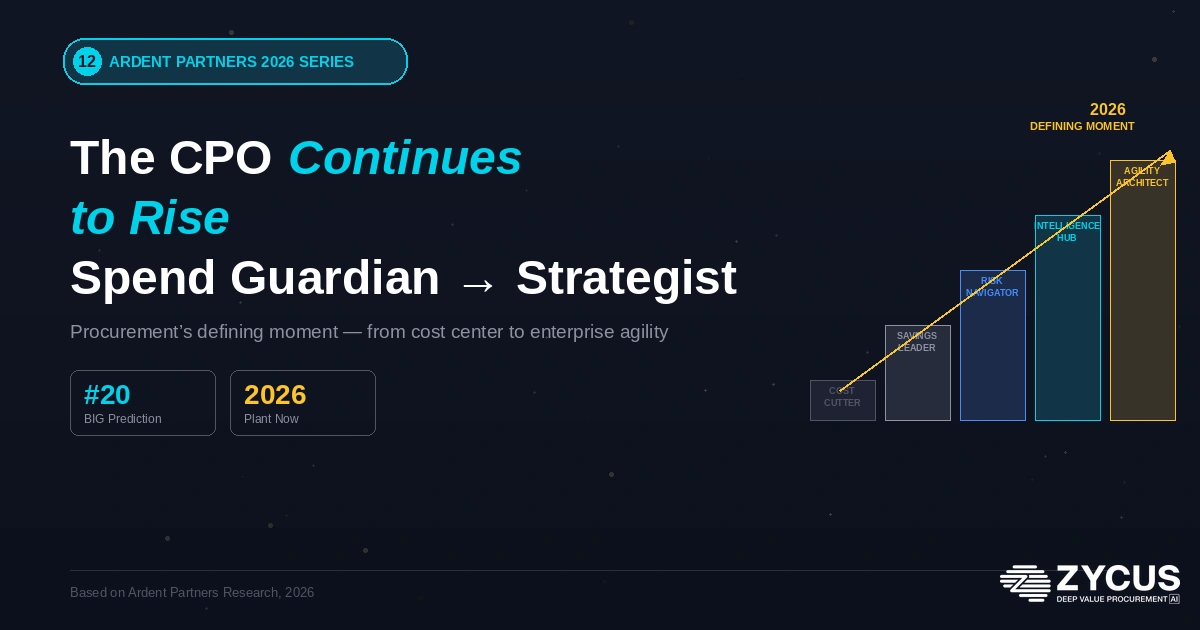
Ardent’s framing of the 2026 CPO is specific: not a cost cutter, not a process manager, but an agility architect. The CPO who can pivot supply chains in response to tariff changes. Who can deploy autonomous systems to capture savings at scale. Who can present boardroom-grade intelligence from a platform the CFO trusts. Who can reshape the workforce without losing institutional knowledge. Who can navigate the infinite loop of trade chaos while maintaining operational continuity.
This is a fundamentally different job description than the CPO of five years ago. And it requires fundamentally different capabilities — not just of the individual, but of the entire procurement organization that supports them.
The report is candid about the gap: many CPOs occupy the title without the strategic mandate. They report to the CFO as a cost center. They lack direct access to the CEO or the board. They are invited to strategy discussions after the decisions have been made. The 2026 inflection point changes this — but only for CPOs who seize it. As Ardent frames it, the CPO is evolving from “spend guardian to enterprise agility architect.”
The Five Forces
The 2026 CPO operates at the intersection of five forces, each of which has been explored in depth through this series:
Autonomous AI systems that can think, reason, and act without human prompts in tactical categories — freeing procurement teams to focus on strategic work while AI handles the long tail. The Genesis of Autonomy is not a technology trend. It is an operating model shift.
Geopolitical fragmentation that has turned supply chain management into a continuous exercise in trade intelligence, tariff modeling, and contingency planning. The world is splintering into competing blocs, and the CPO is the executive who maps the enterprise’s exposure.
Persistent inflation acting as a low-grade fever, with suppliers embedding mini-escalators into every contract. The CPO’s ability to deploy precision savings tools — autonomous negotiation, real-time should-cost modeling, continuous market monitoring — is a direct margin protection function.
Platform intelligence that transforms procurement from a transaction-processing function into the enterprise’s primary window into external market dynamics. The S2P platform as a System of Business Insight gives the CPO boardroom-grade data to present to the CEO and CFO.
Workforce transformation that reshapes the procurement team from process executors to process orchestrators, market analysts, and AI system managers. The CPO who builds this team builds the capability that sustains every other initiative.
No other executive sits at the intersection of all five. The CFO sees the financial picture. The CIO sees the technology landscape. The COO sees the operational flow. The CPO sees the external market, the supplier network, the cost dynamics, the technology capability, and the talent reality — simultaneously. This convergence is what drives the strategic ascent.
What the Board Is Watching
Ardent’s research signals that the board’s expectations of procurement are changing. With the 10-year Treasury approaching 5%, capital is expensive. Every dollar of unnecessary cost reduces the enterprise’s capacity to invest. Every supply chain disruption erodes margin. Every tariff miscalculation destroys competitive positioning.
Boards are no longer content with quarterly procurement scorecards showing PO cycle times and contract compliance rates. They want to know: what is our total tariff exposure? Where is our supplier concentration risk? What savings are in the pipeline for the next two quarters? How are we positioned if a major trade corridor closes? These are the questions that elevate the CPO from a functional leader to a strategic advisor.
The K-shaped divergence applies here too. Organizations where the CPO has built the capabilities described in this series — autonomous systems, real-time intelligence, boardroom-grade data, a skilled workforce — will expand margins and strategic agility. Organizations where procurement remains a siloed cost center will face stagnation or decline. The divergence is structural, and it is accelerating.
2026 Plants. 2027 Harvests.
Ardent’s framing of the 2026–2027 relationship is deliberate and recurrent throughout the report. 2026 is the building year. The seeds planted during this year’s AI pilots, data cleanups, tariff preparations, and talent investments will manifest as major value in 2027.
But the harvest only comes if you plant now. The Five-Wave CPO Strategic Playbook provides the sequenced execution plan: clean the data, build the war room, deploy AI-powered savings, launch the Garage, reshape the workforce. Each wave creates the conditions for the next. And with a potential budget freeze by Q4, the window for initiating these investments is the first half of the year.
The Defining Moment
Ardent’s CPO takeaway on this prediction is the capstone of the entire report: “Position yourself and your team as indispensable strategic partners for the enterprise. Leverage AI, market data, and boardroom-grade insights to ensure procurement’s seat at the executive table is permanent, not provisional.”
The CPO’s rise is not guaranteed. It is earned. Earned through the investments made in 2026, the capabilities built, the intelligence delivered, the crises navigated, and the value created. The CPOs who execute on the Playbook will not need to argue for a seat at the table. They will already be sitting at it.
This is procurement’s defining moment. The technology is ready. The mandate is clear. The framework exists. The question is execution. And the clock is running.
This is the final installment in our 12-part series on Procurement 2026: BIG Trends and Predictions by Ardent Partners. To explore the full research — including all 13 BIG Trends, 20 BIG Predictions, and the Five-Wave CPO Strategic Playbook — download the complete report.
The Ardent Partners report provides the complete 2026 strategic framework for procurement leaders. Download Procurement 2026: BIG Trends and Predictions to access all 13 BIG Trends, 20 BIG Predictions, and the Five-Wave CPO Strategic Playbook.
Continue Reading
Previous in this series: The Hourglass Workforce: How AI Is Reshaping Procurement Talent
FAQs
Q1. How is the CPO’s role evolving in 2026?
Ardent Partners describes the CPO’s evolution from spend guardian to agility architect — the executive who navigates fractured supply chains, deploys AI-powered margin protection, delivers boardroom-grade intelligence, and reshapes the workforce for the autonomous era. This is a structural elevation driven by the convergence of forces that make procurement decisions board-level decisions.
Q2. What does “agility architect” mean for procurement leadership?
An agility architect is a CPO who can pivot supply chains in response to tariff changes, deploy autonomous systems at scale, present trusted intelligence to the CEO and CFO, navigate trade chaos while maintaining continuity, and transform the workforce without losing institutional knowledge. It represents a fundamentally different leadership profile than the traditional cost-focused CPO.
Q3. Why is 2026 the defining moment for CPOs?
The convergence of autonomous AI, geopolitical fragmentation, persistent inflation, platform evolution, and workforce transformation creates a window where CPOs can establish procurement as an indispensable strategic function. Ardent Partners frames 2026 as the planting year and 2027 as the harvest — the investments and capabilities built now determine procurement’s strategic position for the rest of the decade.
Q4. What is the K-shaped divergence for procurement organizations?
Organizations where the CPO has built autonomous systems, real-time intelligence, boardroom-grade data, and a skilled workforce will expand margins and strategic agility. Organizations where procurement remains a siloed cost center will stagnate or decline. This divergence is structural and accelerating — there is no middle ground in 2026.
Q5. What five forces define the 2026 CPO’s domain?
Autonomous AI systems, geopolitical fragmentation, persistent inflation, platform intelligence, and workforce transformation. No other executive sits at the intersection of all five — the CPO uniquely sees external markets, supplier networks, cost dynamics, technology capability, and talent reality simultaneously. This convergence drives the strategic ascent.
Q6. How does the Five-Wave Playbook support the CPO’s rise?
The Playbook sequences the entire 2026 agenda into executable waves: data cleanup, tariff war room, AI-powered savings, the AI Garage, and talent reshaping. Each wave builds capabilities that expand the CPO’s strategic influence. By executing the playbook, the CPO demonstrates indispensable value to the enterprise rather than arguing for relevance.
Related Reads:
- A Comprehensive Guide to Spend Analysis: Process, Benefits & Best Practices
- Benefits and Challenges You Didn’t Know about Spend Management
- A Comprehensive Guide to Spend Management: Definition, Process & Best Practices
- Spend Data Classification: Making sense of Data
- Spend Analysis Benchmark Report: Key Procurement Insights from Aberdeen
- The AI Budget Siphon: How to Fund Procurement’s AI Future