






A live production demo of the Merlin Agentic Platform revealed the difference between AI that answers questions and AI that completes processes, and why the architecture decision is the highest-leverage choice on the CPO’s AI roadmap.
From the Agentic Procurement Summit 2026 · Session 7 · Devika Sanil, Solutions Consulting, Zycus
TL;DR
- This blog covers what the live Merlin Agentic Platform demo at APS 2026 revealed: the gap between AI that answers questions and AI that completes procurement processes end-to-end, and why that gap is architectural.
- Most procurement AI today is an add-on to existing S2P workflows. The agent can answer questions about policy but cannot apply policy autonomously because it lacks embedded process context. This blog explains why that distinction matters.
- The demo ran the full sourcing and negotiation arc in a single agentic flow, from purchase request to award recommendation, with multiple specialized agents orchestrating as a team. This blog covers what it showed about native agent architecture.
- Merlin Intake demonstrated the front-door layer: a catering request submitted in natural language returned supplier alternatives, the applicable process steps, and all relevant information extracted automatically in one conversational exchange.
- Adding a benchmarking agent to the sourcing flow during the session required one natural-language instruction. This blog covers what that deployment model means for the CPO’s architecture decision and AI roadmap.
- The full live Merlin Agentic Platform demo is available at APS 2026 on demand. → Watch the session
What the live demo actually showed
The previous session in this series showed what agentic AI looks like when it runs in live client environments: the Tailwind model working across IBM’s procurement transformation practice. This session answered the question that demonstration raises: how does the technology actually work?
Devika Sanil opened Session 7 by naming the enterprise requirement precisely. Organizations do not want AI as an add-on to traditional applications. They want AI that works in the context of their own data and policies, without months of IT implementation. That framing is precise because it identifies where most AI deployments fall short.
The add-on problem in procurement AI
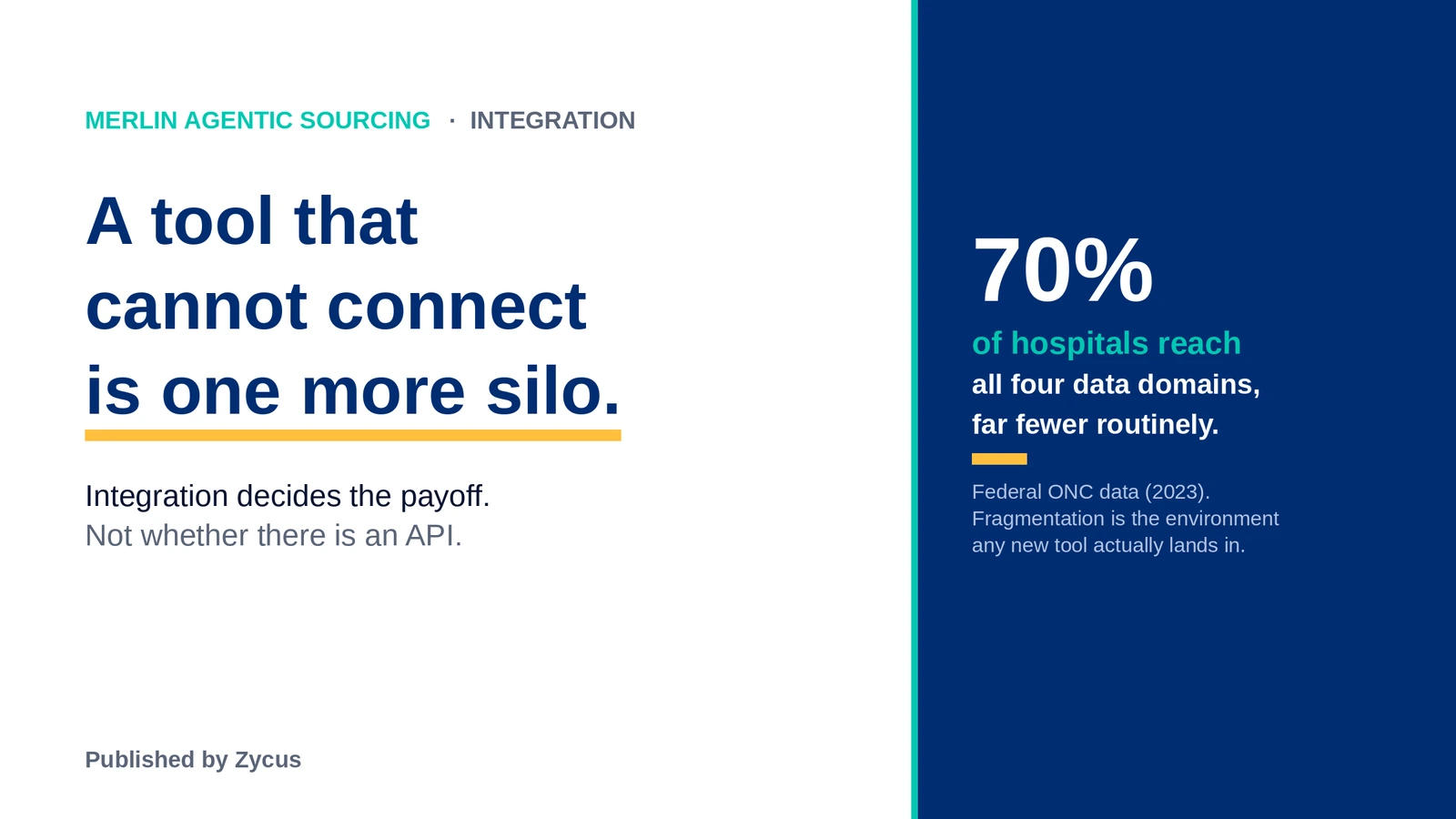
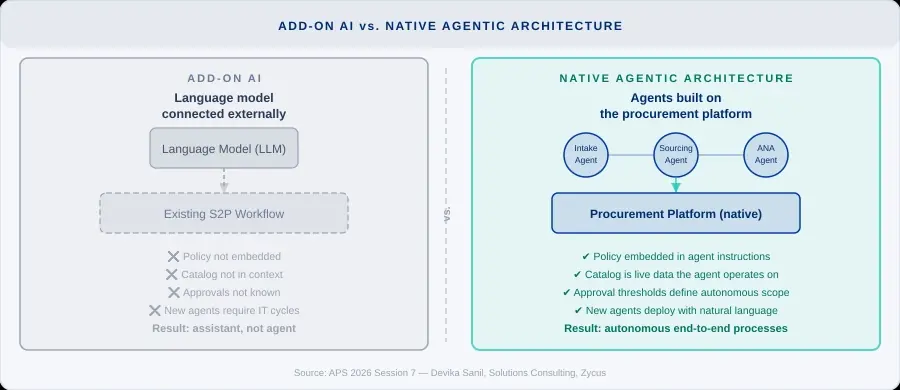
Most procurement AI deployed today is a language model connected to an existing source-to-pay workflow. The model can respond to questions about procurement policy. But it does not know which policy applies to this specific request type, in this organizational context, under this approval threshold. Deloitte’s State of AI in the Enterprise survey of 3,235 leaders found that only 34% of organizations are using AI to deeply transform core processes and business models. A further 37% are using AI at a surface level with little or no change to existing processes . This is the pattern Devika named: AI added to the top of a workflow it was never designed to inhabit.
When the AI has no direct access to the live supplier catalog, the current approval matrix, or the active sourcing events already in progress, it can help a user navigate a workflow, but it cannot navigate the workflow on the user’s behalf. It functions as a search engine with a better interface. That is not an agent. That is an assistant.
What native agents can do that add-ons cannot
When the agent is built on the same platform as the procurement workflow, the context is already there. The procurement policy is encoded in the agent’s instructions at build time, not looked up at query time. The supplier catalog is the live data the agent operates against, not a document the agent reads. The approval threshold is a governance parameter that defines the scope within which the agent can act autonomously.
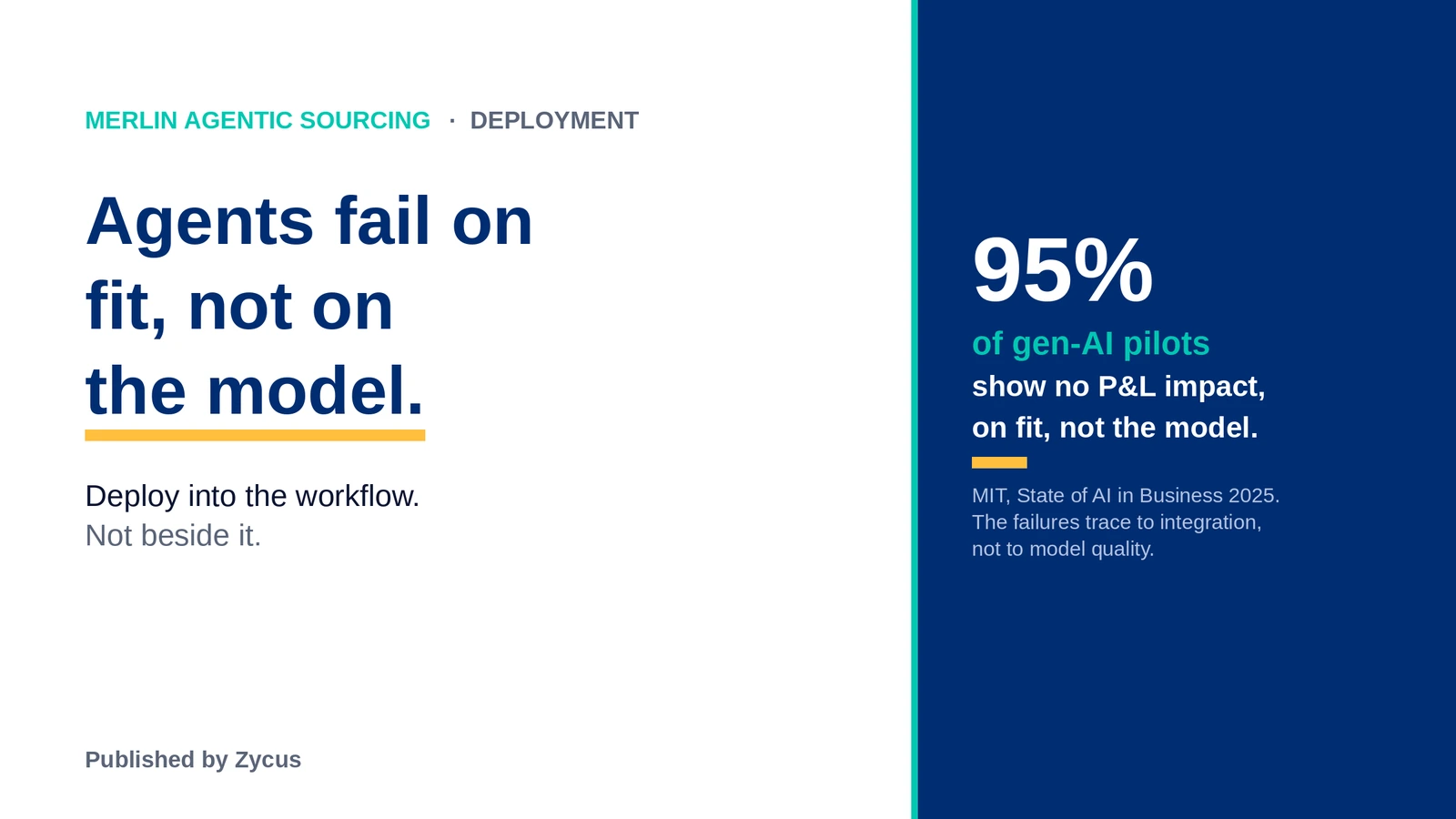
The difference is not which language model the agent uses. It is where in the architecture the agent sits, what data it has direct access to, and what instructions it was given. These factors determine whether the agent completes a procurement process or only assists a human completing one.
The Merlin Agentic Platform in production
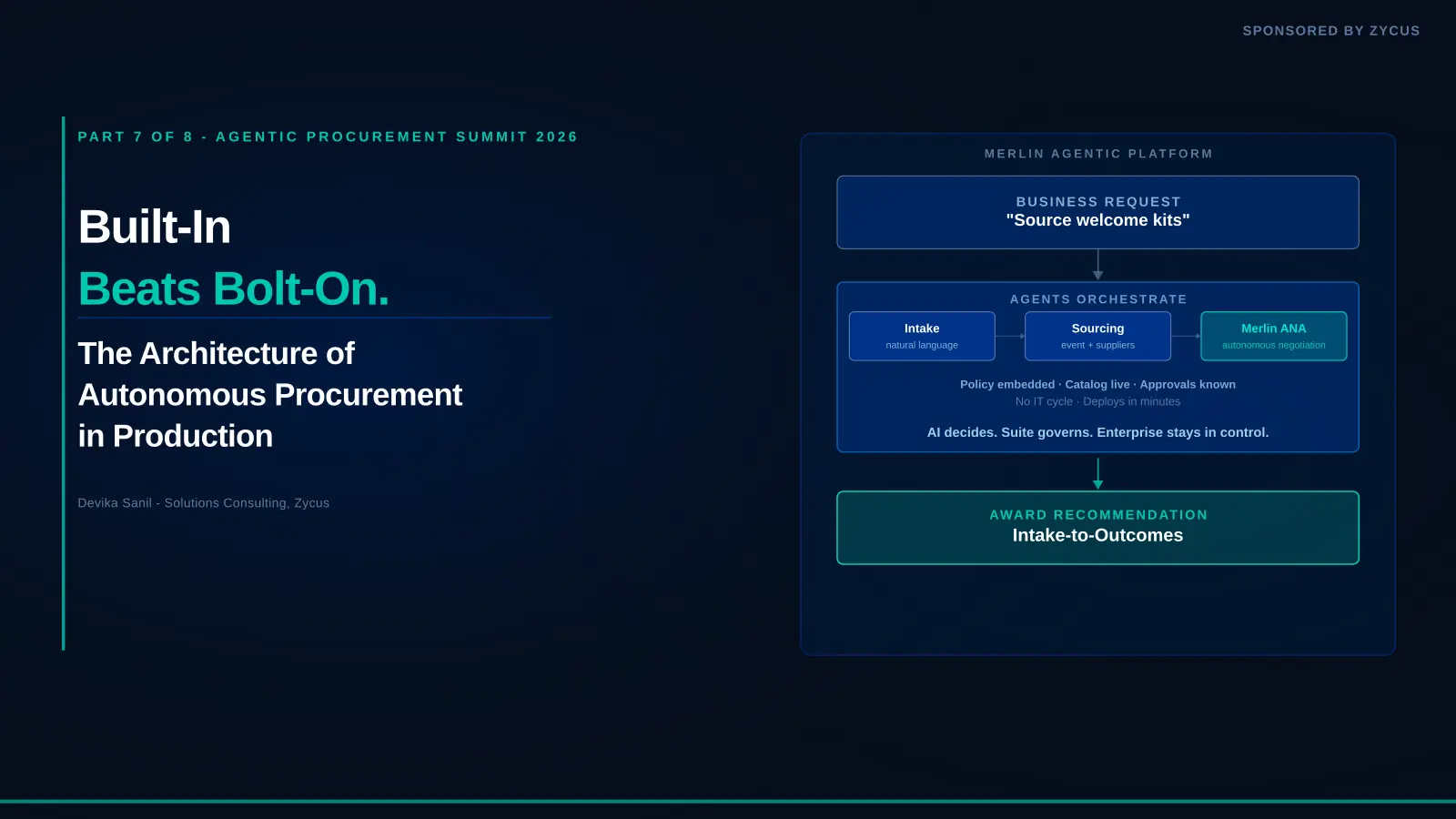
The Merlin Agentic Platform, Zycus’s architecture for building and orchestrating multiple specialized agents into end-to-end procurement flows, demonstrated this in a live production environment during the session. The demo ran the complete sourcing and negotiation arc in a single conversational flow: a purchase request for welcome kits entered the system, the platform selected the applicable request, created the sourcing event, recommended suppliers, published the event, collected bids, initiated autonomous negotiation, compiled a comparative matrix, and produced an award recommendation.
The agents coordinated as a team: PR Selection, Event Creation, Supplier Recommendation, and Merlin ANA (Autonomous Negotiation Agent), each executing its defined step. Human decision points were preserved at governance boundaries: confirming supplier selection, approving negotiation, and making the final award decision. AI decides. Suite governs. Enterprise stays in control.
Merlin Intake and the front door
The session’s second demonstration was Merlin Intake, the AI Control Tower for every procurement request. A user submitted a catering services request in natural language, attaching an existing supplier quote. In a single exchange, the platform extracted the supplier name, event quantity, and quoted amount; checked the internal catalog; searched for alternative suppliers; and returned the required process steps, all without the user selecting a category, completing a form, or knowing which approval workflow applied. The Hackett Group’s 2026 Procurement Key Issues research found that only 12% of organizations report large-scale AI implementation in procurement, with most still operating pilots or single-use-case deployments. The gap between having AI tools and using them to complete processes end-to-end is exactly what native architecture addresses.
Merlin Intake illustrated what happens when the intelligence begins at the first moment of procurement activity. The business user’s intent, expressed in natural language, triggers the full policy and routing logic of the platform. The path to compliance becomes the default path, not an additional step.
Natural language as the deployment model
The session demonstrated something beyond what the platform can do today: how fast it can be extended. Adding a benchmarking agent to the existing sourcing flow required a single conversational instruction , specifying a name, a description, and plain-language guidance on whether to draw from internal or market data. That agent was immediately part of the flow.
This is the deployment model that changes AI rollout economics. When agent instructions are written in natural language on a platform where procurement data already lives, the cycle from identifying a capability to having it in production is measured in minutes, not months.
The CPO’s architecture decision
There are two types of AI in procurement. The first connects a language model to an existing S2P system. Fast to demonstrate in a sales conversation; constrained at scale because the context is not embedded. The second builds agents natively on the procurement platform, requiring the right foundation, but enabling dramatically faster extension and scaling once that foundation exists. Gartner research predicts that 33% of enterprise software applications will include agentic AI by 2028, up from less than 1% in 2024, with at least 15% of day-to-day work decisions made autonomously. The architecture decision determines which side of that curve an organization will be on.
Built-in beats bolt-on as a structural reality. The session proved that architecture exists in production today.
What the demo proved about governance
The APS 2026 session showed something beyond features. It showed a governance model working: autonomous agents completing procurement work within defined scope, human decision points placed at the right governance boundaries, and full visibility into what each agent did and why. This is what Intake-to-Outcomes looks like as an operational architecture rather than a positioning statement.
The final session examines what it actually takes to move from a demo like this to enterprise-wide deployment at scale.
Agentic Procurement Summit 2026. On-Demand Access. Devika Sanil, Solutions Consulting at Zycus, presents the live Merlin Agentic Platform demo at APS 2026. Sponsored by Zycus. → Watch the session
Previous blog in the series: Tailwind in Action: What Agentic AI Actually Looks Like in Procurement
Next blog in the series: Every Organization Has Run a Pilot. Here’s Why Most Don’t Make It to Production
FAQs
Q1. What is the Merlin Agentic Platform, and how does it differ from other AI tools in procurement?
The Merlin Agentic Platform is the layer on which Zycus builds and orchestrates multiple specialized AI agents (intake, sourcing, negotiation, analytics) coordinated into end-to-end procurement flows, built natively on the S2P suite rather than connected externally.
Q2. How does Merlin Intake know which procurement policy applies to a specific request?
Procurement policies are encoded directly in the agent’s instructions at build time. The agent does not look them up; it operates with them already embedded, which is why it can return a compliant process path from a single natural-language request without asking the user to navigate a workflow.
Q3. What is the difference between an AI assistant and a true AI agent in procurement?
An AI assistant answers questions based on prompts and depends on human direction at every step. A true AI agent can plan, use tools, reason about outcomes, and take sequential action toward a goal, such as running a sourcing event from purchase request to award without manual workflow navigation.
Q4. How does Merlin ANA decide when to push for more savings versus accepting a supplier’s final offer?
Merlin ANA analyzes each supplier response against a target price, compares it to its negotiation mandate, and determines whether there is still scope to negotiate further. When a supplier signals a genuine best-and-final position, ANA recognizes that signal and stops pushing, protecting supplier relationships.
Q5. How long does it take to build and deploy a new agent on the Merlin Agentic Platform?
As the APS 2026 demo showed, adding a new agent (such as a benchmarking agent) required one conversational action: a name, a description, and instructions in plain English. The agent was then available in the flow, without an IT implementation cycle.
Q6. What guardrails prevent agents from making decisions outside their authorized scope?
Each agent’s scope is defined in its instructions at build time: what it can decide autonomously, what must be escalated to a human, and what conditions trigger a governance checkpoint. The suite enforces these boundaries; the agent cannot act outside them.
Related Reads: