




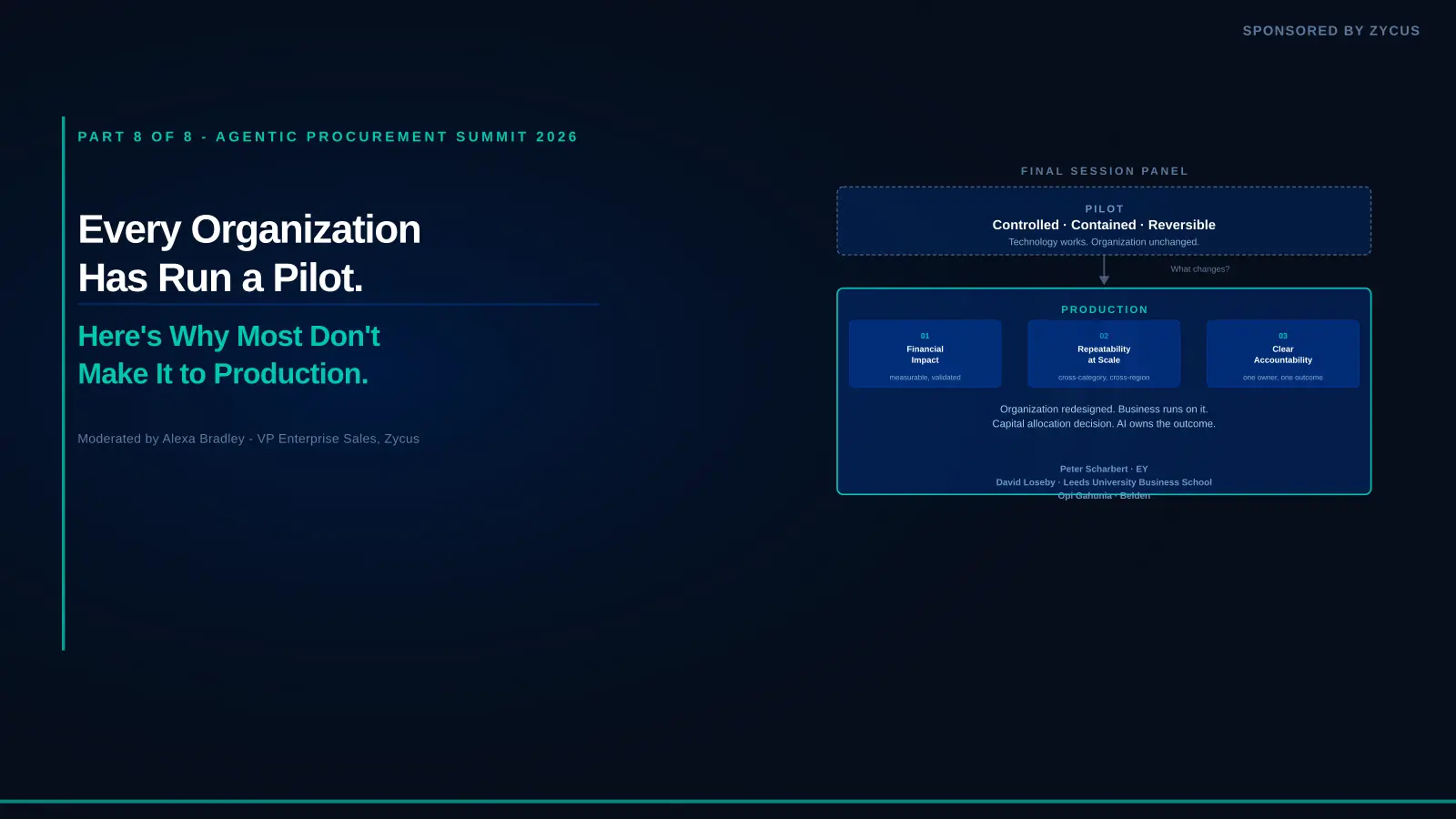

Three procurement leaders who have lived the crossing from pilot to production share what the analyst frameworks don’t cover: the organizational failures, the CFO conversations, the early warning signs, and what actually changes when AI stops being an innovation initiative.
From the Agentic Procurement Summit 2026 · Final Session · Panel: Peter Scharbert, Partner, EY; David Loseby, Professor of Research Impact, Leeds University Business School; Opi Gahunia, Director of Global Indirect Procurement, Belden. Moderated by Alexa Bradley, VP of Enterprise Sales Americas, Zycus
TL;DR
- Three practitioners who have crossed from pilot to production share the lived reality of the gap most organizations cannot close.
- Most pilots succeed because they are contained. Production requires the organization to run on the technology. This blog covers why the gap is harder than it looks.
- The barrier is almost never the technology. David Loseby, behavioral scientist and former Group CPO of Rolls-Royce, explains why.
- Opi Gahunia’s CFO framework: three things every production AI commitment needs before it reaches a capital allocation decision. This blog covers all three and what happens if any one of them is missing.
- Category managers do not lose their jobs when agentic AI goes into production. They change jobs: from executing workflows to supervising decisions.
- Peter Scharbert, David Loseby, and Opi Gahunia close the session with one sentence each for the CPO sitting on a production decision right now. → Watch the session
What this panel had that the earlier sessions didn’t
The previous session in this series demonstrated the technology in live production: a complete sourcing-to-award cycle handled autonomously in a single conversational flow. That session showed what the architecture can do. This final session answered the question that follows from it: what does it actually take to get there?
The panel’s opening premise was direct: every organization in this room has run a pilot. Not everyone has made it to production. What actually changed at the moment when things became real?
Practice versus game day
Opi Gahunia opened with an analogy that landed immediately. Pilot is practice. Production is game day. In practice, you are proving the technology works in a controlled environment. On game day, the organization has to execute and the outcome is what counts. McKinsey’s 2025 State of AI research confirms where most organizations currently sit: nearly two-thirds remain in experiment or pilot mode, with only about one-third having genuinely scaled AI across functions. That gap is not a technology problem. Gartner’s June 2025 research adds a further dimension: among organizations with high AI maturity, 45% keep production AI deployments operational for at least three years compared with 20% of lower-maturity peers.
Most pilots succeed because they are contained: they do not require the organization to behave differently. Production does. It means redesigning the workflow, shifting ownership to the business, and asking teams to trust decisions made by an autonomous system. The constraint is whether the organization is set up to absorb that level of autonomy.
What the EY diagnosis usually finds
Peter Scharbert works with organizations stalled between pilot and production commitment. The diagnosis is almost always the same: the organization fixed the problem the pilot identified but has no plan for how it fits into the larger picture.
That larger picture is a target operating model: how AI fits into governance, IT strategy, system architecture, organization design, and ways of working. Without it, individual pilots generate isolated wins that cannot connect into enterprise-wide capability. Data quality is an under-appreciated prerequisite, and people readiness is equally foundational. As Scharbert put it simply: in the future, everybody will be a manager of AI agents. Not everyone is ready to become a manager today.
Why the technology is the easy part
David Loseby’s background is behavioral science, and his answer to why deployments fail was unambiguous: people. The technology is complex but predictable. People are not. McKinsey’s 2025 State of AI research found that only about 6% of organizations qualify as AI high performers, reporting meaningful EBIT impact. What separates that group from the 94% is not the technology they chose but whether they redesigned workflows, built change management capability, and embedded governance.
Loseby named the specific failure mode: compliance without adoption. Compliance means a user logs in, completes the transaction, and moves on. Adoption means the system is shaping how decisions get made. The warning signs are not obvious at first: workarounds appear, manual fixes multiply, and then everything goes quiet. Silence is the danger signal. If no one is raising issues or asking for fixes, people have stopped engaging. Fix the small things fast, Loseby said, or the adoption curve reverses.
When AI becomes a capital allocation decision
Opi Gahunia framed the shift precisely: when AI moves from pilot to production, it stops being an innovation initiative. It becomes a capital allocation decision. The CFO conversation requires production-level proof. Hackett’s Digital World Class procurement research benchmarks what those returns look like: top-performing procurement organizations deliver 2.6X greater ROI than peers while operating with 31% fewer FTEs and at 19% lower cost. Those returns do not materialize from a pilot.
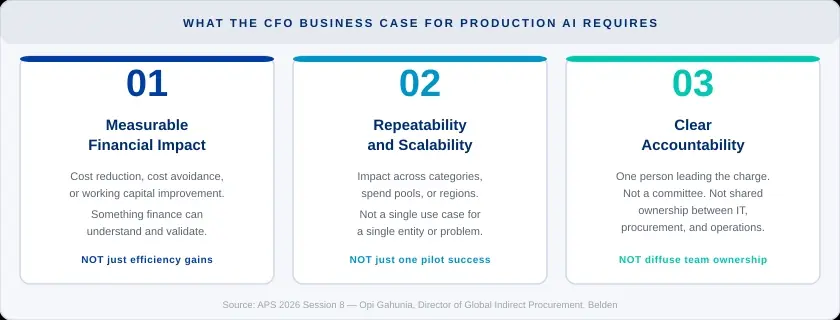
Gahunia’s framework: first, a measurable financial impact that finance can understand and validate. Second, repeatability and scalability across categories, regions, or spend pools, not a single use case. Third, clear accountability: one person responsible for delivering the outcome. When all three are present, the production conversation is fundable. When any one is missing, it stalls.
How to answer the board
Peter Scharbert advises CPOs on the board conversation around full production commitments. The most common objection is whether the investment will pay off. His answer: shift the frame from cost to value creation. Not ‘what does this AI cost the function’ but ‘what does better AI-augmented procurement deliver to the enterprise’: covering unmanaged spend, making better sourcing decisions, reducing fraud and value leakage. A well-performing procurement organization earns multiple of its own functional cost, and AI makes that proposition stronger. CPOs who make that case, rather than an IT investment case, win the board conversation.
What changes for the team on the ground
The final audience question went to Opi Gahunia: once agentic AI is in production, how does the team’s day actually change? His answer was specific. Category managers shift from executing workflows to supervising decisions. Instead of spending time setting up sourcing events, they spend time defining guardrails: what does a good procurement decision look like in this category, where are the exceptions that require human judgment, where is the risk?
Buyers shift from processing transactions to exception handling. The 80% that is routine and repetitive is handled autonomously; the 20% where supplier judgment, relationship context, or exception logic matters remains human. The transition is not a training exercise. As Gahunia put it: simplify and align how each person gets their work done, and adoption follows.
Three sentences for the CPO sitting on a production decision
Peter Scharbert: develop a clear vision of the AI-augmented target operating model so you can sell the value case to your stakeholders. Do not get paralyzed by the ambition of 100% perfection from the start. Accept that production is a learning journey.
David Loseby: do not forget the people right at the outset. Not as a post-design consideration. As a first principle, end to end.
Opi Gahunia: get out of practice and get in the game. One use case, clear ownership, measurable outcomes, real accountability. That is where the learning happens.
Eight sessions covered every dimension of this shift: research, architecture, governance, execution evidence, technology in production, and the lived reality of getting there. The organizations that close that gap built from Intake-to-Outcomes, and earned the trust that lets the system run.
Agentic Procurement Summit 2026. On-Demand Access. The full panel discussion with Peter Scharbert, David Loseby, and Opi Gahunia is available in the APS 2026 Resource Center. Sponsored by Zycus. → Watch the session
Previous blog in the series: Built-In Beats Bolt-On: The Architecture of Autonomous Procurement in Productio
FAQs
Q1. What is the most common reason a procurement AI pilot stalls before reaching production?
Peter Scharbert’s diagnosis: lack of a clear target operating model. Organizations fix the problem their pilot identified but have no plan for how it fits into governance, IT strategy, organization design, and ways of working. Without that vision, the question of whether to proceed to production stays unanswered.
Q2. How do you distinguish genuine adoption from mere compliance?
David Loseby’s distinction: compliance means someone logs in, completes a transaction, and moves on. Adoption means the system is shaping how decisions get made and surfacing insights that were not accessible before. The test is not whether people are using the system. It is whether you are getting the insights and value the system was designed to produce.
Q3. What are the early warning signs that an AI deployment is in trouble?
David Loseby’s list: workarounds and manual fixes appearing alongside the digital process; month-end reports showing missing transactions or failed payments; and most importantly, silence. If users are not raising issues and asking for fixes, that is not a sign of smooth adoption. It is a sign that people have already stopped engaging. Fix small problems fast or watch the adoption curve reverse.
Q4. What does the CFO conversation for a full production commitment actually need to include?
Opi Gahunia’s three requirements: measurable financial impact (cost reduction, cost avoidance, or working capital improvement that finance can validate); repeatability and scalability across categories, regions, or spend pools rather than a single use case; and clear accountability, meaning one person responsible for delivering the outcome. When AI moves to production, it competes for capital against every other investment in the business.
Q5. How does a category manager’s role change once agentic AI is in production?
Buyers shift from processing transactions to exception handling: the 80% that is routine is handled autonomously; the 20% requiring judgment remains human. The transition between models is not primarily a training exercise. As Gahunia put it: simplify and align how each person gets their work done, and adoption follows.
Q6. What is the single most important thing a CPO should do before committing to full production?
Peter Scharbert: develop a clear vision of the AI-augmented target operating model before anything else. Know how the AI fits into your governance, your workflows, your organization design, and your value case. Then don’t get paralyzed by the need for 100% perfection before starting. Accept that production is a learning journey, not a launch event.
Related Reads: